Two-Shot Injection Molding with TPE and Thermoplastics: A Design Guide

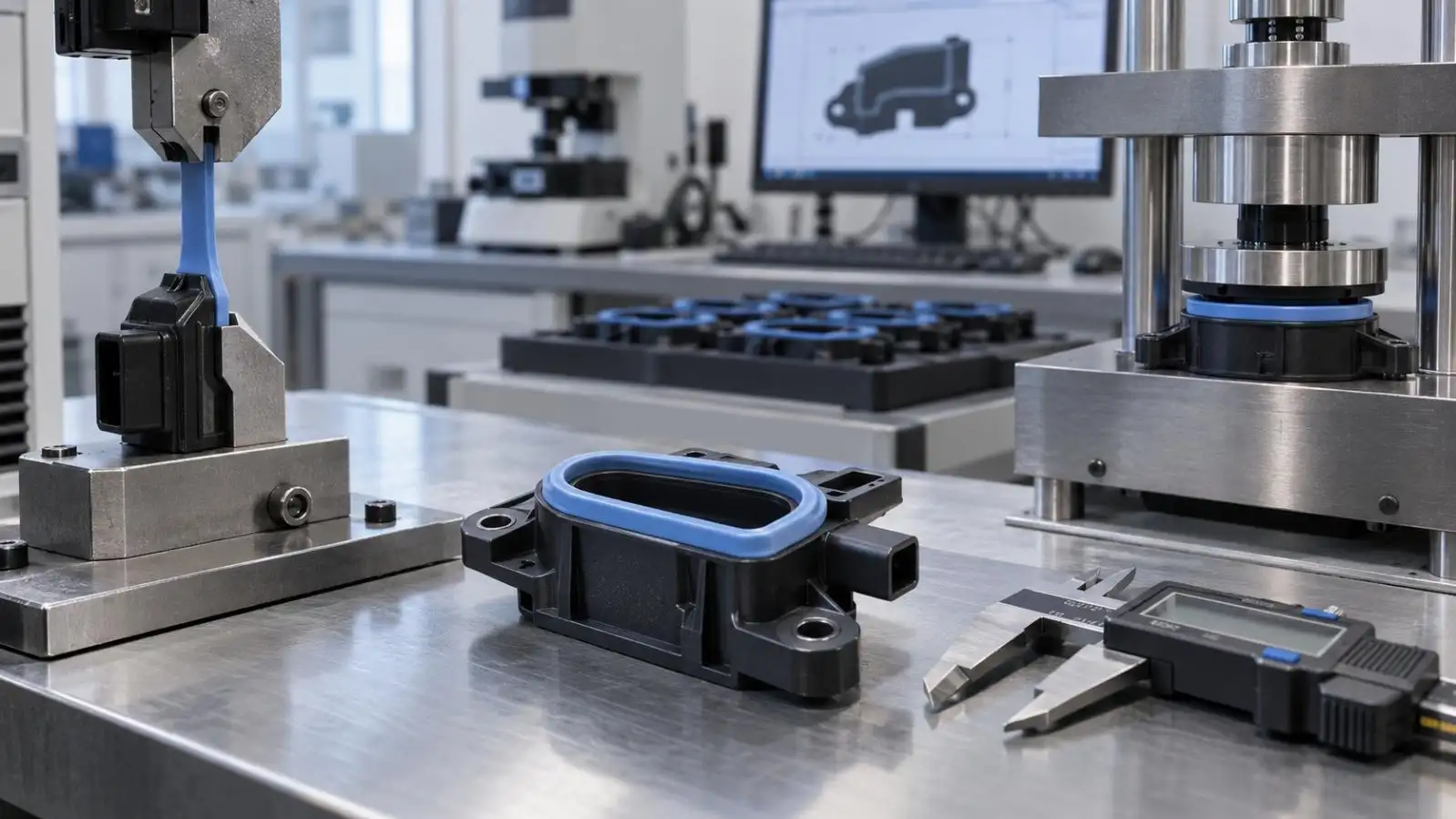
Table of Contents


In Two-Shot Injection Molding, parts of rigid substrates can be molded together with thermoplastic elastomers (TPE) for an improved grip or cushioning or sealing. However, the challenge arises in maintaining this combination during molding and assembly as well as during the service life.
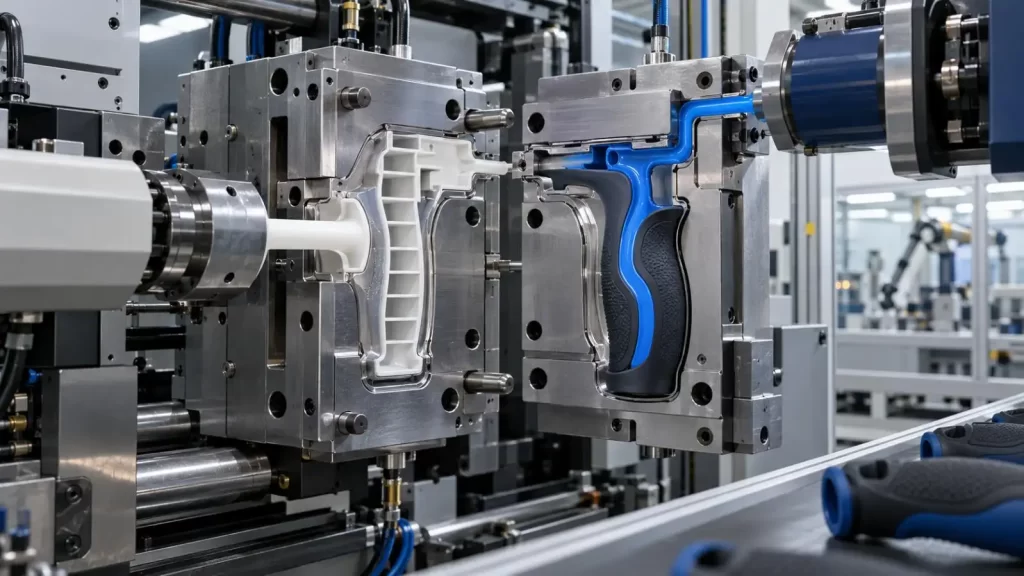
At Yijiang, our manufacturing workflow starts with 3D-file review and DFM analysis where needed. For a proposed two-material component, the practical starting point is to define the interface requirements before committing to tooling.
Define Performance Before Choosing Materials
A comfortable handle and a durable seal require different material properties. Shore A hardness alone cannot predict either result.
| Application | Critical Properties | Design and Validation Priority |
| Tool grip | Friction, abrasion resistance, chemical resistance | Grip security after wear and cleaning |
| Housing seal | Compression set, stress relaxation, fluid resistance | Sealing force across the assembly tolerance range |
| Protective bumper | Energy absorption, recovery, tear resistance | Repeated impact at service temperatures |
| Flexible button | Fatigue resistance, force response | Actuation consistency over repeated cycles |
For Two-Shot Injection Molding, specify exposure temperature, cleaning agents, loading, expected life, and acceptance criteria alongside hardness.
Material Compatibility in Two-Shot Injection Molding
TPE is a family of materials, not a universal bonding resin. Compatibility must be established between specific commercial grades, including their fillers, colorants, and additives.
| Rigid Substrate | Material Selection Approach | Main Risk to Resolve |
| PP | Select a TPE formulated for PP adhesion | Inadequate adhesion or differential shrinkage |
| ABS | Use an ABS-compatible adhesion grade | Interface weakness within the chosen processing window |
| PC / PC-ABS | Match the compound to the exact substrate | Thermal distortion and inconsistent bonding |
| PA | Match nylon type and reinforcement | Moisture-related variation and aged adhesion |
KRAIBURG TPE describes formulation-dependent adhesion across PP and engineering thermoplastics. A material-family match therefore narrows selection; it does not replace trials.
Separate Adhesion from Mechanical Retention
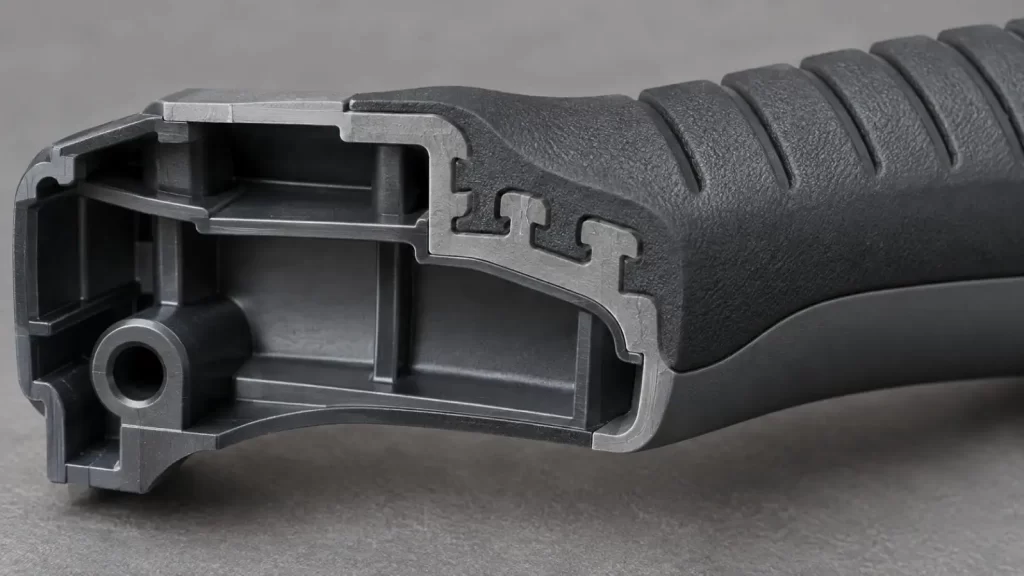
Interfacial adhesion transfers load across the material boundary. Through-holes, grooves, and undercuts can provide additional mechanical retention.
Use retention features where peel loads or geometry justify them, but check their effects on filling, tooling, and stress concentration. A mechanically retained TPE layer is not automatically a sealed interface.
Design the Interface for Filling and Service Loads
Two-Shot Injection Molding requires both materials to function as one dimensional system.
Wall Thickness and Edge Geometry
• Keep TPE sections consistent: Thin sections require precision to fill; thick sections allow cooling to start.
• Use gradual changes and radii: Highly abrupt changes will disrupt flow and concentrate stress.
• Protect exposed edges: Thin feather edges fail to fill and peel.
• Create deliberate closing surfaces: The tool needs to stop the second material from spreading or damaging the first material.
• Plan draft and ejection: The soft features need to release or eject without damaging the feature with tear or permanent set.
Avient's design guidance suggests consistent walls with gradual changes throughout the thickness range that is specific to the material and geometry.
Substrate Support and Tolerance Stack-Up
The first-shot component must withstand second-shot heat and cavity pressure. Unsupported walls can deflect, changing TPE thickness or creating flash.
For a seal, evaluate the minimum and maximum assembled compression, including substrate dimensions, soft-layer variation, mating-part tolerances, and shrinkage. A precise rigid component alone cannot establish reliable sealing.
Establish a Repeatable Two-Shot Injection Molding Process
A successful trial should become a stable operating window.
| Process Variable | Engineering Concern | Control Priority |
| Material conditioning | Moisture or contamination | Grade-specific drying and handling |
| Substrate temperature and transfer time | Changing interface conditions | Repeatable timing and thermal state |
| Gate position and venting | Restricted flow, trapped gas | Fill balance and vent effectiveness |
| Injection and packing | Flash, deformation, incomplete filling | Validated settings within material limits |
| Cooling and ejection | Distortion or soft-feature damage | Adequate support and consistent release |
Two-Shot Injection Molding coordinates sequential shots within an integrated process. Transfer overmolding introduces a separate substrate-handling stage, which changes tooling and process-control requirements.
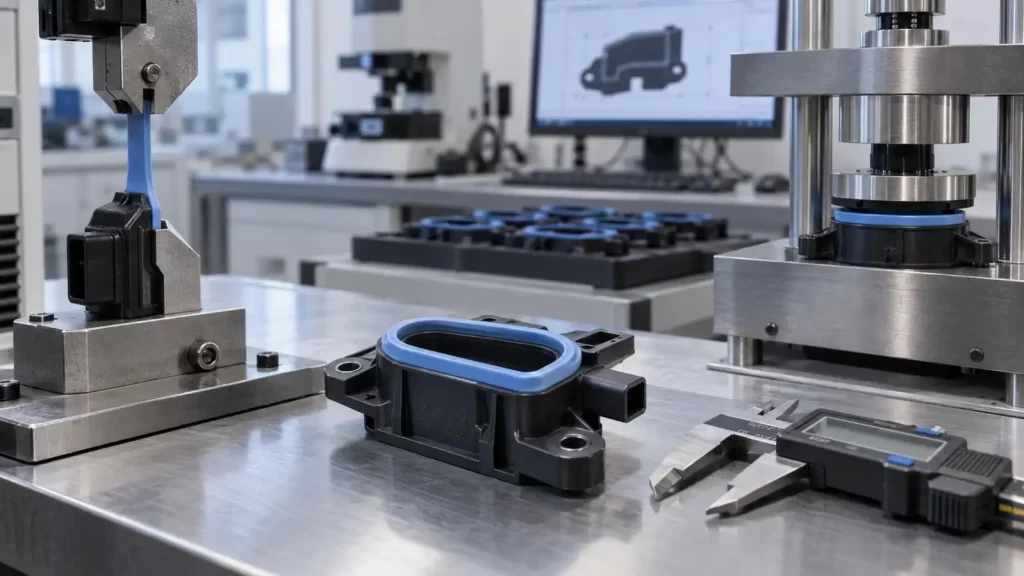
Validate the Failure Mode, Not Just Appearance
Describe acceptance criteria before final approval is given:
• Adhesion: Include the pull/peel test; include the specimen's geometry, loading rate, and the conditioning treatment
• Failure Mode: Disambiguate whether separation is occurring at the interface or within the TPE.
• Aging: Perform any tests specified after the sample has been subjected to either thermal, chemical, or moisture conditioning.
• Dimensions: After specified conditioning, measure the critical dimensions.
• Function: Cycle the sample through the leak/abrasion test/button compression/actuation and any other relevant tests.
A sample that looks good is not enough to show long-term adhesion or functional durability.
Compare Manufacturing Routes on Total Cost
| Decision Factor | Two-Shot Injection Molding | Transfer Overmolding | Separate Assembly |
| Investment | Typically higher integration cost | Separate tooling and handling | Component tooling plus assembly |
| Production fit | Stable, recurring demand | Projects with lower integration justification | Changing designs or serviceable products |
| Labor | Less intermediate handling | Placement and transfer work | Assembly operations |
| Yield exposure | Either shot can reject the part | Placement adds variation | Assembly introduces defects |
| Changes and repair | Coupled geometry | Some process flexibility | Components may be replaceable |
Evaluate tooling amortization, cycle time, scrap, inspection, labor, and design-change risk. Production volume alone does not determine the best route.
Bringing the Design into Production with Yijiang
Our injection molding capabilities include 30+ machines, 50–2500-ton clamping forces, and precision up to ±0.02 mm. These are general capability figures; achievable tolerances depend on material, geometry, and the measured feature.
We offer TPE processing, overmolding, rapid and production molds, and trial validation. For Two-Shot Injection Molding, the configurations and combination of materials, and inspection planning will be evaluated during the project review.
For Yijiang's engineering team, send through CAD files, service conditions, critical dimensions, and the expected volume. These inputs help in evaluating the way the component can be manufactured and the production route that can be adopted.
FAQs
Q1. Can Yijiang Support a Two-Shot Injection Molding Project?
Yijiang lists overmolding, TPE processing, and mold development among its services. For a Two-Shot Injection Molding project, confirm the required equipment configuration, material combination, and tooling approach with its engineering team.
Q2. Which Materials Does Yijiang List for Injection Molding?
Yijiang lists TPE, TPU, PP, ABS, PC, PC/ABS, and PA materials, among others. Availability does not establish compatibility: each proposed rigid-plastic and TPE pairing requires grade-specific evaluation.
Q3. What Injection Molding Precision Does Yijiang Advertise?
Yijiang advertises precision up to ±0.02 mm. This is a general capability figure, not a guaranteed tolerance for every component. TPE features require separate assessment based on geometry, material behavior, and measurement conditions.
Q4. What Is Yijiang's Injection Molding Equipment Capacity?
Yijiang reports more than 30 injection molding machines with clamping forces from 50 to 2500 tons. These figures describe its overall equipment range; dedicated two-shot configurations should be confirmed for the proposed project.
Q5. Does Yijiang Provide Design for Manufacturability Reviews?
Yes. Yijiang's published workflow includes reviewing 3D files, performing DFM analysis when needed, and preparing process plans. For two-material parts, request attention to substrate support, shutoff surfaces, wall thickness, and dimensional requirements.
- PREV: Null
- NEXT: Null

Yijiang is a professional custom manufacturing partner specializing in large-scale injection molding and precision mold development. We support global clients in automotive,
in large-scale injection molding and precision mold development. We support global clients in automotive,


Get a quote from the China’s #1 CNC Machining Services.
Ready to get started? Connect with us today!
 Talk to Our Team