Home » Production Tooling Maintenance in 2026: How Predictive Maintenance Is Changing Injection Molding
Production Tooling Maintenance in 2026: How Predictive Maintenance Is Changing Injection Molding

Table of Contents

- Why Fixed Maintenance Intervals Cannot Fully Predict Mole Wear
- Which Sensor Data Can Reveal Tooling Problems?
- Cooling-Circuit Monitoring: Detecting Problems Before Dimensional Drift
- When Does Predictive Data Justify Precision Mold Repair?
- Yijiang Technology's Precision Machining Capabilities
- How Should Tool Performance Be Verified After Maintenance?


Flash starts appearing in one cavity of a multi-cavity mold after 200,000 production cycles. The process settings have not changed, yet the defect becomes more frequent. Increasing clamp force might suppress it temporarily, but it will not correct a worn parting surface, damaged insert, or alignment problem.
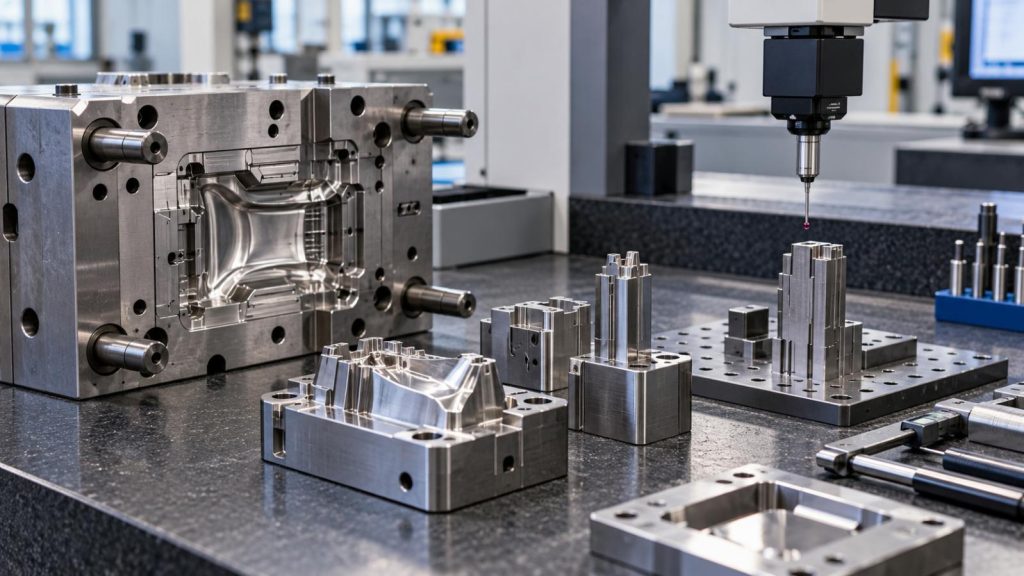
Conventional Production Tooling Maintenance would typically trigger an inspection at a predetermined shot count. Predictive maintenance takes a different approach: it examines changes in operating behavior to determine whether the tooling is deteriorating and where inspection should begin.
In 2026, expanding instrumentation, signal conditioning, and data acquisition systems will be less important than defining mold deterioration outside of typical process constraints. There will have been a significant advancement in mold detection.
Why Fixed Maintenance Intervals Cannot Fully Predict Mole Wear
Shot counts do not give an indication of mold deterioration and mechanical condition.
It is important to remember that multiple mold variations may exist within the same mold base. Although wear mechanisms may be similar, they will not necessarily be the same. For example, the wear mechanisms for a mold that processes an unfilled polypropylene would be different from a mold that processes a glass fiber reinforced polyamide.
Cooling systems present another problem. Mineral deposits accumulate according to water chemistry, temperature, and operating conditions—not necessarily production cycles.
These differences explain why identical maintenance intervals can produce opposite outcomes: premature servicing of healthy molds and unexpected failures in heavily stressed tools.
At Yijiang Technology, we view condition monitoring as a supplement to scheduled maintenance. Cleaning, lubrication, corrosion protection, and periodic dimensional inspections remain necessary, particularly where deterioration produces no reliable early-warning signal.
Which Sensor Data Can Reveal Tooling Problems?
Predictive monitoring works best when a measured variable has a defensible connection to a particular failure mechanism.
Machine injection pressure, for example, may increase because of gate restriction, but also because resin viscosity has changed. The signal identifies a process deviation; it does not prove that the gate requires machining.
| Monitoring signal | Possible failure mechanism | Verification before repair |
| Cavity pressure drift | Gate wear or restriction, filling imbalance | Compare cavity-specific pressure profiles under matched process conditions |
| Rising ejector force | Galling, deposit buildup, pin misalignment | Inspect pins, bushings, lubrication, and ejection resistance |
| Reduced cooling flow | Scale deposits, corrosion, circuit blockage | Check flow rate, pressure drop, filters, and water passages |
| Abnormal acoustic emission | Slider wear, unstable mechanical contact | Inspect guide clearances and contact surfaces |
| Increasing cavity-to-cavity variation | Uneven wear, thermal imbalance, flow restriction | Compare part weights, dimensions, and individual cavity behavior |
Why Baseline Conditions Matter
A cavity-pressure alarm becomes unreliable if the comparison ignores material lot, melt temperature, injection velocity, or velocity-to-pressure transfer settings.
For meaningful trend analysis, monitoring data should be associated with the mold identification number, machine, resin grade, processing recipe, and maintenance history.
A stable reference window is more valuable than an arbitrary universal alarm threshold.
Cooling-Circuit Monitoring: Detecting Problems Before Dimensional Drift
Cooling deterioration is a useful application for predictive Production Tooling Maintenance because internal restrictions are difficult to observe without testing.
Mineral deposits add thermal resistance between the mold steel and coolant. A partially blocked circuit also changes coolant velocity and local heat transfer.
Increased cooling times are not the only concern with improper temperature control. Other effects may include warped or distorted molded parts, and inconsistent dimensions of formed cavities.
Simply reading the displayed temperature of the temperature-control unit will not identify the aforementioned problems.
A more thorough investigation will include the flow of the coolant, the temperatures of the coolant prior to and after flowing through the mold, the pressure of the circuit, and the temperature of the mold surface.
The coolant removes heat from the mold and must be considered in the analysis.
Q = ṁ x Cp x ΔT
Where ΔT is the temperature difference of the coolant prior to and after it flows through the mold.
If flow of the coolant through the mold has decreased, the temperature difference may increase; however, it does not necessarily mean that more heat was removed from the mold.
When Does Predictive Data Justify Precision Mold Repair?
Prior to performing a chemical cleaning or disassembling a mold, it is advised that the technicians check filters, valves and temperature-control units to make sure that the hoses and fittings are secure. Cleaning agents must be compatible with the seals and protective plating of the mold.
Precise mold repair should be performed only after an anomalous signal has been determined to be coming from the mold, and not after the first or second occurrence of a problem.
Ejector pins may also be bent or worn. The replacement of ejector pins restores normal operation of the mold but does not correct the problem.
For precision repair, component geometry and operating clearance must be evaluated together.
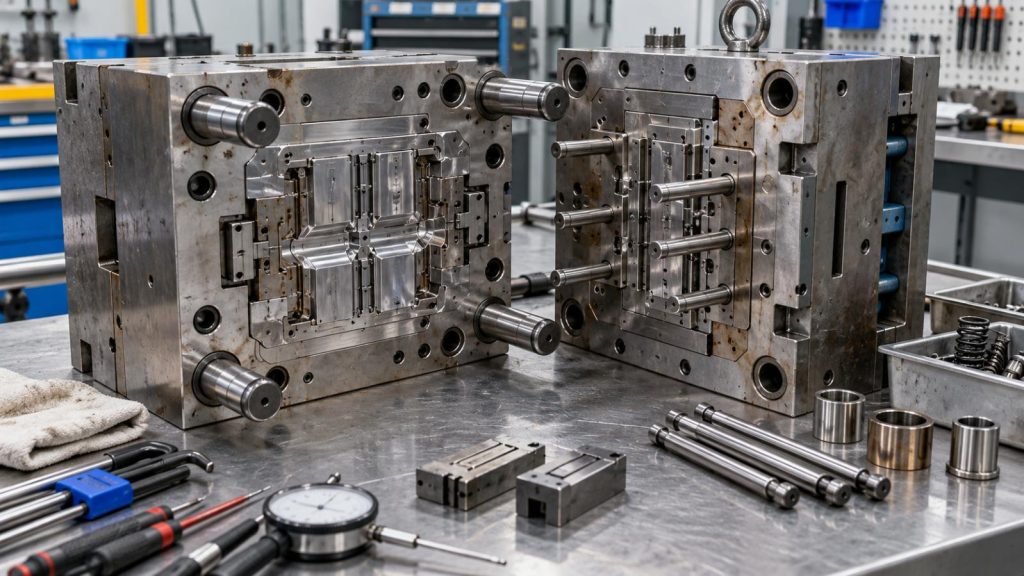
Yijiang Technology's Precision Machining Capabilities
At Yijiang Technology, the following is our advanced manufacturing services:
• Milling to ±0.01 mm is achievable. Features requiring even tighter tolerances may be possible through EDM and grinding, with tolerances as low as ±0.005 mm, depending on the component and the requirements of the feature.
• Precision machining of mold cavities and components can be achieved to tolerances of ±0.005 to 0.01 mm.
• We perform all forms of maintenance on molds, including restoration, repair and modification. Worn or missing components are replaced, and the condition of the mold is assessed using different techniques including Coordinate Measuring Machines.
What is described above is our understanding of the limits of machinability of various component materials.
Heat treatment of a mold is another restoration method that must take into account the material properties and the geometry of the components with which the mold mates.
In certain cases, restoration of a mold may not be warranted and the cost of the restoration would outweigh the benefits.
When determining the most cost-effective strategy for the maintenance of a production mold, there are many factors to consider. These would include the lead time for replacement components and the reliability of the maintenance data.
Advanced manufacturing processes, like 3-D printing, offer an alternative to traditional restoration methods. The cost to acquire and implement a predictive maintenance system would also need to be evaluated.
Demonstration of useful fault-detection performance under actual operating conditions justifies the financial investment in a monitoring system. Assessing tool performance entails evaluating the rate of false alarms and the rate of missed failures.
How Should Tool Performance Be Verified After Maintenance?
Although monitored readings of a repaired mold indicate that the mold is normal, the mold should not be released for normal production.
Mold dimensions and conformal cooling circuits should be checked for leaks and flow, respectively. Ejector and slider mechanisms should be functionally tested.
Trials to evaluate the mold should be performed to determine if critical dimensions and other defects are within the acceptance limits.
The record of the preventative maintenance should document the components replaced, monitored results, and any changes to the monitoring threshold.
Yijiang Technology has experience in the maintenance of injection molds, mold component and precision replacement, and tooling modifications. We invite our client's engineers to provide component drawings, inspection reports and findings to help our engineers evaluate mold repair and/or wear.
FAQs
Q1. Does Yijiang Technology provide production tooling maintenance services?
Yes. Yijiang Technology provides mold inspection, repair, modification, polishing, and replacement of worn tooling components.
Q2. How does Yijiang Technology identify injection mold maintenance problems?
Our maintenance work covers wear, flash, damaged mold surfaces, cooling problems, and unstable mechanical movement. Inspection findings guide the repair scope.
Q3. Does Yijiang Technology provide predictive maintenance sensor systems?
Our published capabilities cover mold maintenance and precision machining. Dedicated predictive monitoring hardware or software services require separate confirmation.
Q4. What machining tolerances can Yijiang Technology achieve for mold components?
Our CNC milling capabilities include ±0.01 mm standard precision, with ±0.005 mm achievable for suitable features. Final tolerances depend on component requirements.
Q5. Can Yijiang Technology replace worn mold inserts and ejector components?
Yes. We provide replacement machining and maintenance support for worn mold components, including inserts and ejection-related parts.
- PREV: Null
- NEXT: Null

Yijiang is a professional custom manufacturing partner specializing in large-scale injection molding and precision mold development. We support global clients in automotive,
in large-scale injection molding and precision mold development. We support global clients in automotive,


Get a quote from the China’s #1 CNC Machining Services.
Ready to get started? Connect with us today!
 Talk to Our Team