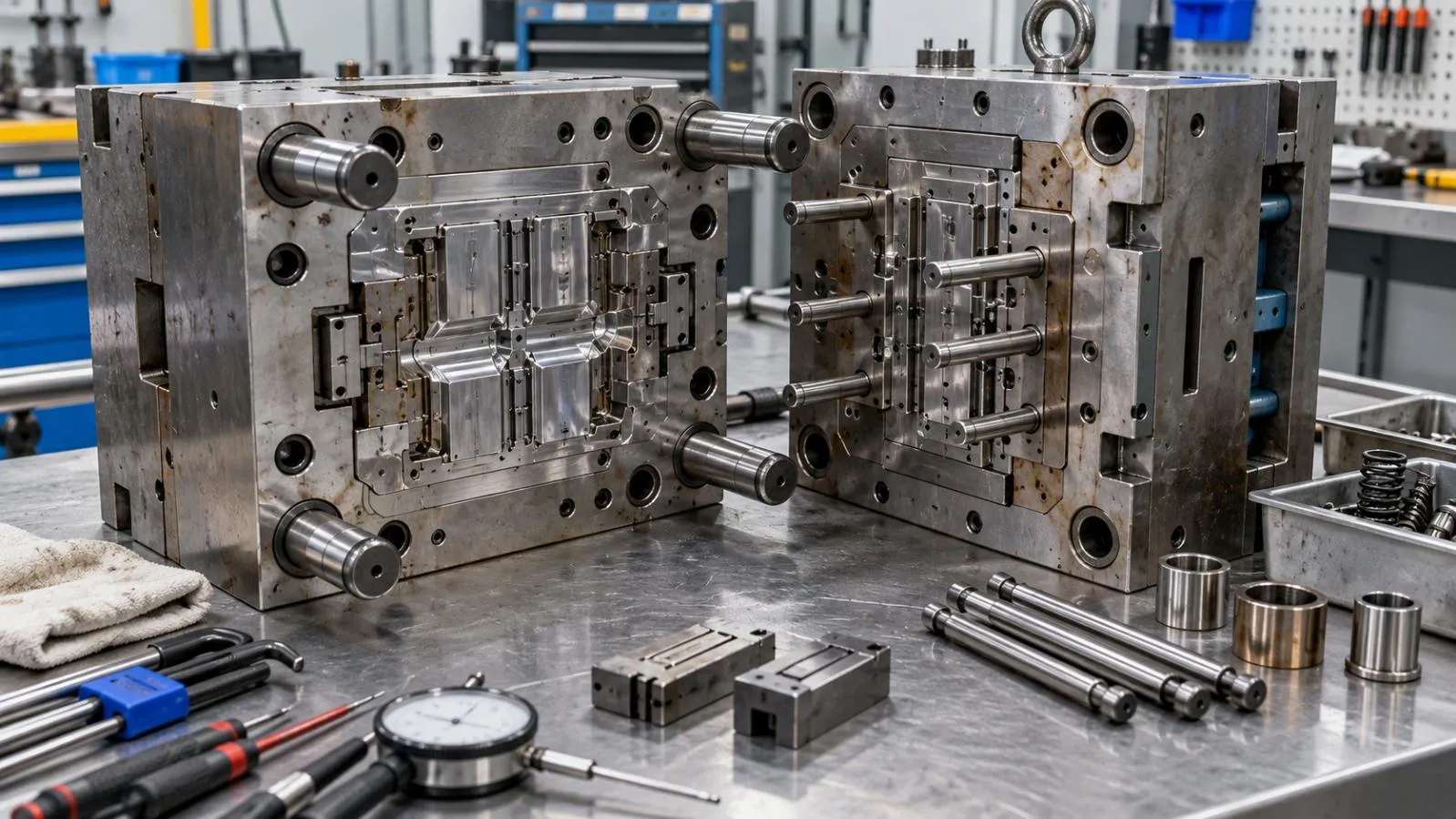
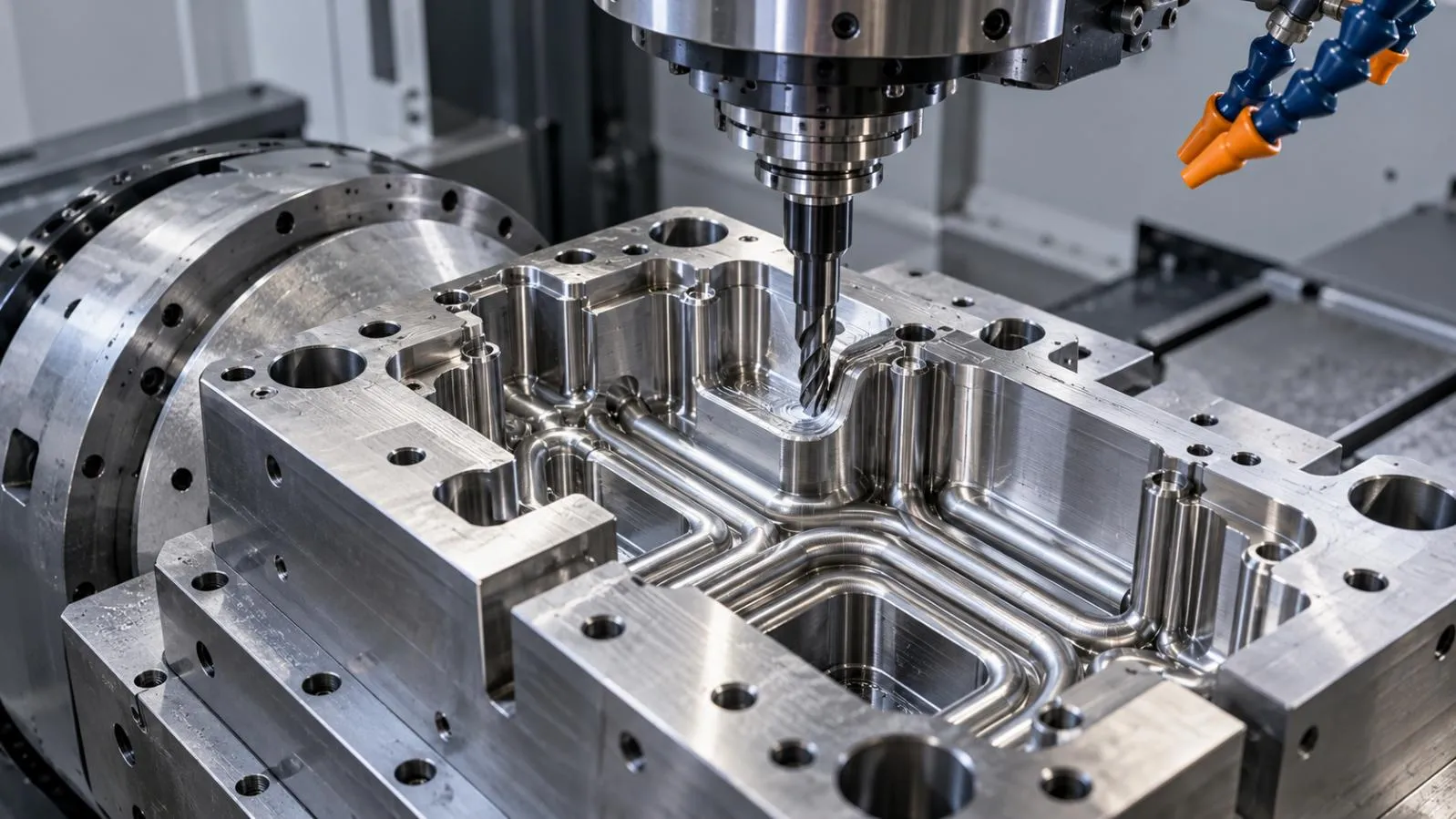
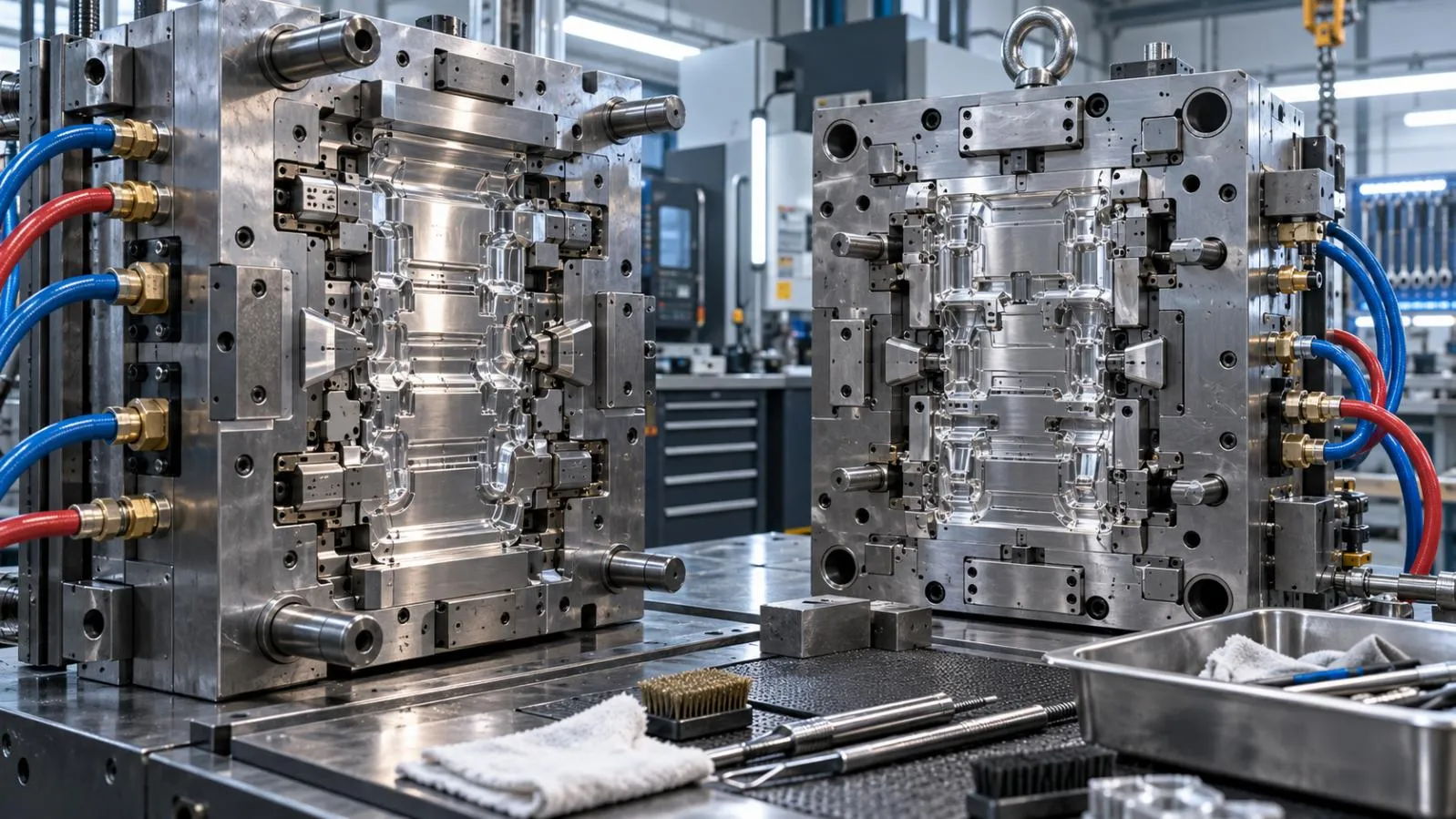
Mold Design for Manufacturing with Recycled Plastics

Table of Contents

- 1. Which Recycled-Resin Properties Must Be Qualified Before Tool Design?
- 2. How Does Recycled Material Affect Part Geometry and Weld-Line Strength?
- 3. Gate, Runner, and Cooling Decisions: What Changes with Recycled Feedstock?
- 4. Why Is Virgin-Resin Shrinkage Data Insufficient?
- 5. How Can Engineers Separate Material Problems from Mold Defects?
- 6. What Should Buyers Require Before Approving Production Tooling?


A mold qualified with virgin polypropylene may produce dimensionally acceptable parts using one batch of post-consumer recycled (PCR) resin, then develop short shots, flash, or inconsistent warpage after a material-lot change. The problem is not necessarily the mold geometry. Recycled feedstock can vary in molecular weight distribution, contamination, and filler content, even when its nominal melt flow rate remains within specification.
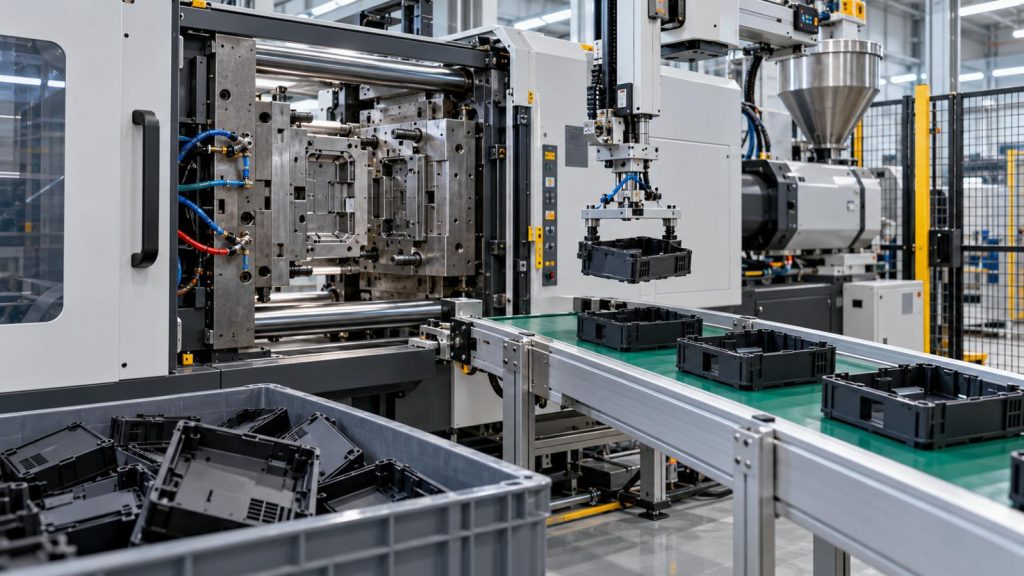
In design for Mold Manufacturing, challenges consist of integrating variations in a way that does not compromise critical dimensions, mechanical function and performance and cycle time. Prior to steel cutting, tooling decisions have to be made based on material considerations and validated on representative lots of resin.
1. Which Recycled-Resin Properties Must Be Qualified Before Tool Design?
Recycled polymers rarely behave as direct substitutes for virgin grades. Post-industrial recycled (PIR) material from a controlled production stream may offer better compositional consistency than mixed-source PCR, but actual batch testing remains necessary.
Melt flow rate (MFR) is a useful screening parameter, not a complete measure of moldability. Two recycled PP grades with similar MFR values can exhibit different viscosities under injection-molding shear conditions because of differences in molecular weight distribution or formulation.
Prior to defining gate dimensions and shrinkage allowances, Engineers need to assess the following.
• Rheology: This can be understood by looking at flow curves and determining the shear stress and rate at which the melt flows.
• Molecular Degradation: Chain scission can occur during processing, and can reduce the molecular weight and increase the toughness of the polymer.
• Contamination and Filler Content: When mineral fillers are incompatible with the polymer, they can influence the flow behavior of the polymer as well as the strength of weld lines.
• Moisture Sensitivity: During the processing of certain polymers, like PET, PA and PC, in the presence of moisture, hydrolytic decomposition can occur.
• Mechanical Retention: For a polymer, the elongation at break can become the limiting factor for snap-fits and clips.
When processing a polymer, like PET, PA and PC, a lot of variability is acceptable, as long as the variation does not affect the function of the part.
2. How Does Recycled Material Affect Part Geometry and Weld-Line Strength?
Increasing wall thickness is not a reliable way to compensate for variable recycled-resin quality. Thicker sections require more cooling and can develop sink marks or internal voids when packing is insufficient.
A more useful DFM review examines abrupt thickness transitions, flow restrictions, stress concentrations, and the location of knit or weld lines.
Thin Walls and Structural Features
Higher-viscosity material may freeze prematurely in thin ribs or long flow paths, particularly when the local cavity surface temperature is low.
Sometimes speed of injection can be increased to improve filling; however additional shear heating and subsequent pressure buildup in the mold may create problems. Other considerations may include, flow length, wall thickness, gate location, and the pressure required to fill the mold.
Snap-fits typically present a challenge to a mold designer. If a recycled polymer with a low elongation at break is used, it may contain dimensions within tolerances but still crack during assembly.
Critical features should therefore be validated with molded-part deflection, assembly, and fatigue testing where applicable.
Weld Lines and Polymer Compatibility
When melt fronts reunite around a hole or core, weld-line strength depends on temperature, pressure, interfacial contact, and molecular interdiffusion.
Incompatible polymer contamination can further weaken the interface.
Moving the gate may relocate the weld line away from a load-bearing region. Where relocation is impractical, functional testing should establish whether the joint meets its mechanical requirements.
Mold-flow simulation helps identify probable weld-line locations, but cannot independently establish strength without suitable material data and physical validation.
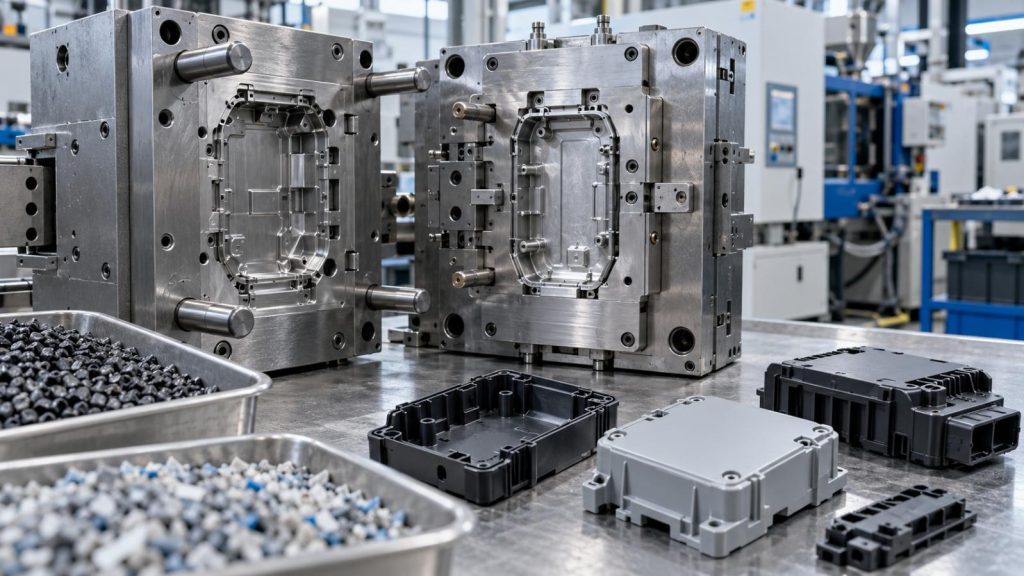
3. Gate, Runner, and Cooling Decisions: What Changes with Recycled Feedstock?
The most useful tooling changes are those that maintain an acceptable processing window across qualified material lots.
| Tooling decision | Engineering trade-off | Verification method |
| Gate geometry | A larger gate may improve packing but increase gate vestige and sealing time | Gate-freeze study, part-weight measurements, dimensional checks |
| Hot vs. cold runner | Hot runners reduce runner scrap but can increase thermal residence-time exposure | Residence-time assessment, discoloration and degradation checks |
| Cavity venting | Insufficient venting causes gas traps; excessive vent clearance can cause flash | Short-shot studies, burn-mark inspection, vent condition checks |
| Cooling layout | Uneven mold temperatures alter local shrinkage and warpage | Mold-temperature measurements, dimensional mapping |
For recycled formulations containing thermally sensitive components, runner residence time matters as much as melt temperature.
A hot-runner system may retain material through production interruptions. Excessive thermal exposure can produce degradation products, surface streaks, or deposits.
Cold runners avoid extended residence in a heated manifold, but create additional sprue and runner scrap. Reintroducing that scrap into production requires approval because repeated processing may alter material properties and the declared recycled-content formulation.
Vents should also be accessible for cleaning. Some recycled feedstocks generate deposits that progressively restrict air evacuation during long production runs.
4. Why Is Virgin-Resin Shrinkage Data Insufficient?
Packing history, cooling rates, and molecular alignment, in addition to other factors, affect shrinkage, and recycled content is only one of several relevant aspects.
For example, changes in the mode of crystallization of semicrystalline polymers like PP can alter shrinkage behavior, while the base polymer remains the same.
• Shrinkage behavior of a recycled formulation can be different from that of the virgin material.
• Reliable prediction of shrinkage behavior of recycled plastics is not possible.
• For controlled dimensional characteristics of parts, it is recommended to:
• Conduct simulations, where available, using qualified material data.
• Validate packing and filling using representative resin lots.
• Measure critical dimensions following a specified cooling and stability conditioning.
• Provide adequate tolerance to ensure that steel safe adjustments can be made, if required, to critical dimensions.
Where shrinkage is direction-dependent, dimensional inspection should distinguish flow-direction and transverse measurements.
5. How Can Engineers Separate Material Problems from Mold Defects?
Changing machine settings after every resin delivery may temporarily restore acceptable parts while concealing a narrow or unstable molding window.
Higher viscosity typically increases filling-pressure demand. Lower viscosity may increase flash susceptibility where cavity sealing or clamping is marginal. Neither relationship should be treated as universal across mixed-polymer feedstocks.
Trial molding should record fill time, peak injection pressure, transfer position, cushion, part weight, and critical dimensions.
Where cavity-pressure monitoring is available, pressure profiles provide additional evidence of packing differences between lots.
A gate-seal study can identify whether holding pressure remains effective long enough to compensate for shrinkage. Extending holding time beyond gate freeze does not meaningfully improve cavity packing.
Production trials should include representative low- and high-flow material lots within the agreed purchasing specification. A process that passes only with one carefully selected batch has not demonstrated robust manufacturability.
6. What Should Buyers Require Before Approving Production Tooling?
The acceptance of tooling and qualification of the plastic material should be combined for projects with recycled plastics.
Simultaneously, procurement and engineering should evaluate documentation pertaining to:
• The supplier's identification of the plastic, recycled content, lot specific, and change control.
• Processing limits, conditioning, and reuse of the plastic.
• Variations in dimensions and performance of the product.
• Mold trial results, action taken, and repetitive results during production.
Statistical process control should only be implemented when absolutely necessary. Prior to any testing, criteria and sampling should be agreed upon.
Total cost should be evaluated based upon the price of the tooling, resin, and plastic, as well as changes in cycle time, scrap, and the need for modification of the tooling. A decrease in the cost of the raw material does not reduce the cost of the final product.
There should be a separate evaluation for regulatory requirements pertaining to traceability and plastic restrictions.
Final Words
Yijiang Technology offers numerous services to evaluate the feasibility of a project including CNC, EDM, mold manufacturing. Sample moldings are provided to validate the mold and provide design and process flexibility.
For projects involving the use of recycled plastic polymers, Yijiang Technology should be provided design and manufacturing requirements in order to define the product design space.
FAQs
Q1. Does Yijiang Technology provide Mold Design for Manufacturing services?
Yes. Yijiang Technology provides DFM analysis, mold structure design, mold-flow simulation, precision mold manufacturing, and trial molding.
Q2. Can Yijiang Technology design injection molds for recycled plastics?
Yijiang can review tooling requirements for recycled-plastic projects. Material compatibility and processing performance must be verified using the proposed resin formulation.
Q3. How does Yijiang Technology evaluate shrinkage and warpage risks?
Yijiang uses DFM reviews, mold-flow analysis, trial molding, and dimensional inspection to evaluate filling behavior, shrinkage, and potential deformation.
Q4. What recycled plastic materials can Yijiang Technology process?
Yijiang lists experience with materials including PP, ABS, PC, PA, and other engineering plastics. Compatibility with specific recycled grades requires project-level confirmation.
Q5. Does Yijiang Technology provide mold-flow analysis before manufacturing?
Yes. Yijiang uses CAE mold-flow simulation to evaluate filling behavior and identify potential molding defects before tooling production.
- PREV: Null
- NEXT: Null

Yijiang is a professional custom manufacturing partner specializing in large-scale injection molding and precision mold development. We support global clients in automotive,
in large-scale injection molding and precision mold development. We support global clients in automotive,


Get a quote from the China’s #1 CNC Machining Services.
Ready to get started? Connect with us today!
 Talk to Our Team