Professional Mold Cleaning Services: Dry Ice or Chemical Cleaning?

Table of Contents

- What Is Actually Contaminating the Injection Mold?
- When Does Dry Ice Cleaning Make Engineering Sense?
- What About Chemical Cleaning?
- Dry Ice vs. Chemical Cleaning: Which Offers Better Process Control?
- Why Does Manufacturing Precision Change the Cleaning Decision?
- How Should Engineers Verify Cleaning Results?
- What Should Buyers Check Before Accepting Mold Cleaning Services?


Mold burn marks start appearing after multiple thousands of cycles. Adjustments are made to the process by the technician to increase the vent time and decrease the injection speed. Burn marks return. It is found that there are deposits of degraded polymer that are sticking to the vent and restricting it.
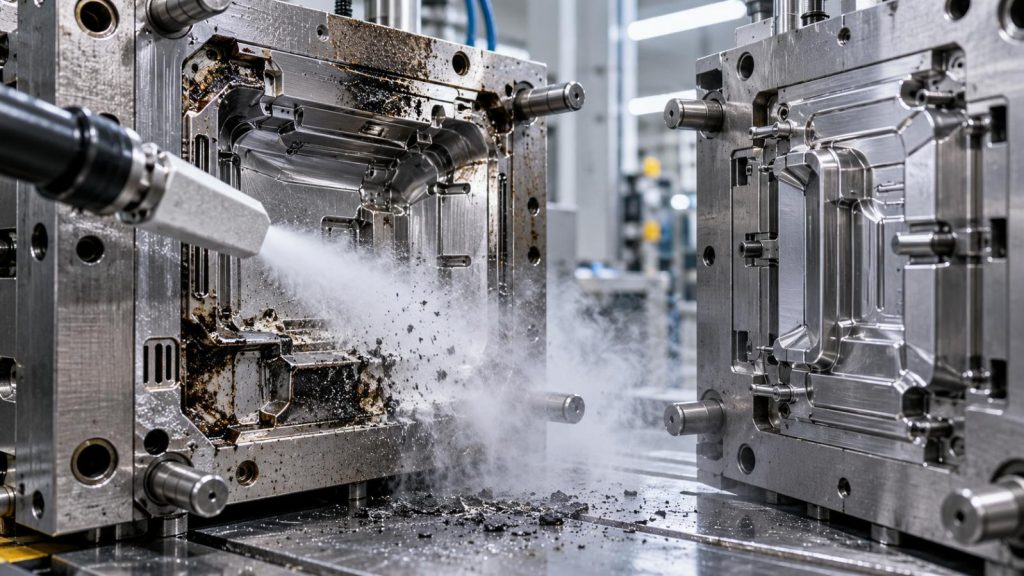
The immediate problem is contamination. The more difficult question is how to remove it without damaging precision-machined vent edges, cavity finishes, or protective coatings.
For engineers evaluating Professional Mold Cleaning Services, dry ice blasting and chemical cleaning offer different removal mechanisms, operating constraints, and maintenance costs. Neither method is universally suitable. The decision starts with the deposit, not the cleaning equipment.
What Is Actually Contaminating the Injection Mold?
Injection molds are subject to several forms of contamination during use, primarily degradation and additive residues, release agents, and processing oils. These contaminants are not always removed by standard cleaning practices.
Contaminants of Injection Molds
•Oils and Greases: Injection molding oils and greases may be removed by the use of a degreasing agent.
•Release Agent Films: Release agent films may be removed by conventional means.
•Corrosion and Scale: The removal of these contaminants would require further evaluation.
•Carbonized Resin: These contaminants are considered rigid and tenacious and therefore would require more aggressive means for their removal.
Location matters as much as chemistry. Deposits on an exposed cavity are accessible to blasting. Contamination inside an ejector bore or cooling passage presents a different problem.
Before specifying cleaning, Yijiang Technology recommends identifying the affected features and distinguishing contamination from mechanical wear, vent damage, or improper mold alignment.
When Does Dry Ice Cleaning Make Engineering Sense?
Dry ice blasting accelerates solid CO₂ particles through compressed air. Particle impact, localized cooling, and rapid sublimation help fracture and detach contamination.
Because the particles sublimate, no solid blasting medium remains. Detached deposits, however, still require collection.
Best Applications and Operating Limits
Dry ice is particularly useful for accessible cavity surfaces, parting lines, and vent deposits. Some molds can be cleaned while installed in the press, provided the machine is safely isolated and the cleaning arrangement allows adequate access.
Cleaning performance depends on:
•Particle size, impact velocity, and nozzle geometry
•Deposit adhesion and thickness
•Mold temperature and surface condition
•Distance and angle between nozzle and target surface
Increasing blast intensity is not always the best solution. Threatening conditions can arise for subtle features such as thin coatings and edges. In these cases, best practice is to use controlled conditions and a limited number of shots.
Dry ice also has its limitations. It cannot penetrate blind passages and recessed cooling circuits. Very difficult carbonaceous deposits can remain stable and adherent to substrates, even when the surface from which they are removed is fully accessible.
The Truth of the Matter: The use of dry ice can alleviate stalemates in mold cleaning; however, it can also generate unwanted residual stresses in mold features.
What About Chemical Cleaning?
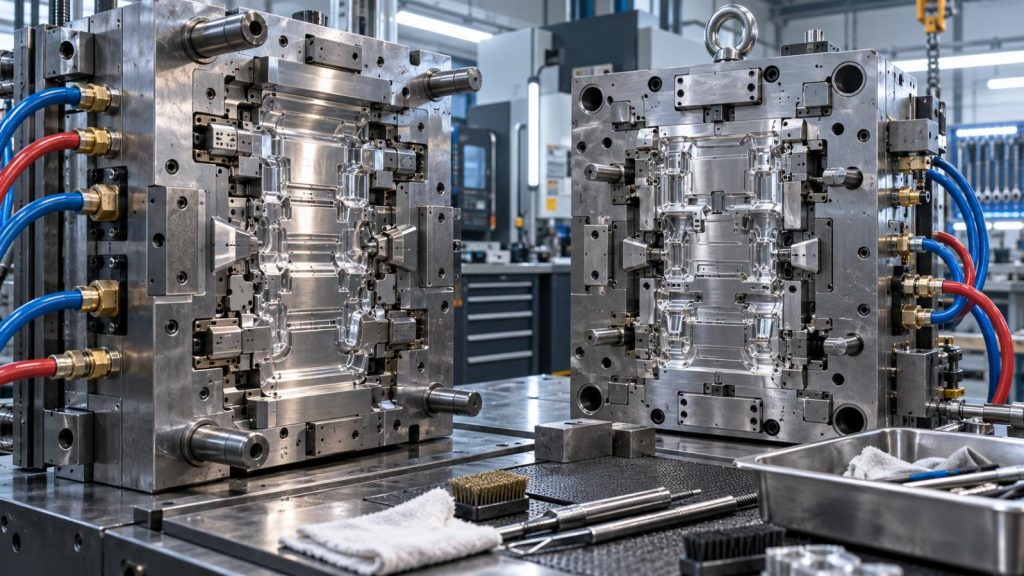
Chemical Cleaning services can be a more attractive alternative, when particle impact is not an option.
Depending on the composition of the contaminant, a hydrocarbon or a specially formulated cleaner can do the trick.
In cases where access of cleaning agents can be achieved, features that are inaccessible to blasting nozzles can be cleaned.
Chemical cleaning can present a wide array of failure mechanisms, including attacks on mold features or sealing compounds, or residue formation due to incomplete rinsing.
Extended exposure can be particularly problematic around narrow ejector clearances and enclosed features, where chemicals may remain trapped.
For coated or mirror-polished cavities, compatibility must be established against the actual substrate and surface treatment—not merely the general designation of mold steel.
A useful selection rule: Choose chemical cleaning when the deposit is chemically removable and adequate contact, rinsing, drying, and corrosion protection can be controlled.
Dry Ice vs. Chemical Cleaning: Which Offers Better Process Control?
| Engineering Factor | Dry Ice Blasting | Chemical Cleaning |
| Primary removal mechanism | Impact, thermal effects, sublimation | Dissolution, emulsification, chemical reaction |
| Strongest application | Accessible surface and vent contamination | Oils, soluble films, deposits requiring chemical treatment |
| Internal geometry | Limited by nozzle accessibility | Immersion or circulation possible |
| Surface damage risk | Impact and localized thermal effects | Chemical incompatibility or coating attack |
| Post-cleaning work | Remove debris; inspect surfaces | Rinse or wipe where required; dry and protect |
| Main safety concern | CO₂ accumulation and blasting hazards | Chemical exposure, ventilation, waste handling |
A mixed approach may be appropriate for complex tooling: dry ice for accessible cavity deposits, followed by compatible localized chemical cleaning of specific components.
Internal cooling-channel descaling is a separate maintenance operation. It requires assessment of channel materials, corrosion condition, circulation chemistry, and flushing requirements.
Why Does Manufacturing Precision Change the Cleaning Decision?
At Yijiang Technology, we have achieved CNC milling tolerances of ±0.01 mm for selected features. Under specific conditions, EDM and grinding can achieve tolerances of ±0.005 mm. The cavity and component precision of molds manufactured by us is approximately ±0.005 to ±0.010 mm. Exact tolerances depend on the shape, material and other parameters of the component to be manufactured.
The statements above should not be understood as guaranteed cleaning accuracy of injection molded parts or definition of cleaning tolerances.
Cleaning the injection molded parts has to maintain the features created in the mold and their surface finish.
Take the example of a molded vent with closely controlled depth. The vent can be obstructed by deposit. When the deposit is removed, the vent is open and the gas can flow again. However, blasting with too much force can damage the vent and change its geometry.
The same concern applies to shut-off interfaces, polished optical cavities, and precision-fitted inserts.
At Yijiang Technology, mold maintenance is considered alongside machining, inspection, and tooling condition. Cleaning should remove contamination without introducing a new dimensional or surface-quality problem.
How Should Engineers Verify Cleaning Results?
Visual cleanliness alone is insufficient, especially when the original complaint involves recurring molded-part defects.
The baseline acceptance process consists of the following:
1. Pre-cleaning. Locate deposits, affected cavities, and defects. Identify critical areas. Describe processing conditions. If restrictions exist, state those restrictions.
2. Post cleaning. Evaluate parting lines and vent and ejector runs. Evaluate cavity finishes. If tool steel is sensitive, evaluate surface and/or dimensional comparisons to baseline.
3. Interrupt processing. Determine if there exists mechanical binding. Evaluate connections and, if a mechanical interlock exists, do not remove it. Test parts should be made to evaluate mechanical function and interlock. Evaluate surface defects and compare to original defect record.
Flash and surface defects have many possible root causes. Prior to repeating a cleaning process, evaluate possible reasons for these defects. Surface defects are often caused by mechanical wear during the processing of the part or resin.
All cleaning records should be maintained and document the method of cleaning, the inspection, and corrections.
What Should Buyers Check Before Accepting Mold Cleaning Services?
When purchasing Professional Mold Cleaning Services, a customer must look beyond the cost to clean mold. There are other elements that need consideration, including the methodology to be employed, the materials to be utilized, the level of disassembly, the type and extent of inspection, and the period of production loss.
Many operations employing dry-ice or chemicals require the generation and containment of by-products. Adequate controls need to be in place to safe guard personnel and the work environment.
The cost to return a mold to service must include all elements incurred in the restoration, including the loss of production, inspection and machine re-alignment.
Contact Yijiang Technology to Discuss Maintenance of Your Molds
Yijiang Technology provides a broad range of support to customers to include inspections, cleanings, and lubrication of molds and tooling. The company offers protective services and documentation to its customers.
To provide a maintenance plan, our team assesses customer molds and tooling to understand the service and contamination needs. To establish the service level needed to meet the customer requirements, our team may conduct a critical surface assessment of the mold.
Visit Yijiang Technology to discuss your mold maintenance requirements.
FAQs
Q1: What professional mold cleaning services does Yijiang Technology provide?
Yijiang Technology provides mold maintenance covering contamination inspection, surface cleaning, debris removal, lubrication, corrosion protection, and maintenance checks.
Q2: Does Yijiang Technology use dry ice or chemical cleaning for injection molds?
Our published maintenance procedures include dry ice blasting, solvent cleaning, and brushing. Method selection depends on contamination, mold materials, accessibility, and surface requirements.
Q3: When is dry ice cleaning preferable for injection molds?
Dry ice cleaning is suitable for accessible cavity surfaces, parting lines, and vent deposits when blasting conditions can be controlled without damaging precision features.
Q4: When should chemical mold cleaning be considered?
Chemical cleaning is suitable for compatible oils, release-agent residues, and soluble deposits, particularly when immersion or localized treatment provides better access.
Q5: How does Yijiang Technology protect precision mold surfaces during cleaning?
We consider mold materials, surface treatments, critical dimensions, and contamination locations when assessing maintenance requirements. Sensitive features require appropriate cleaning controls and inspection.
- PREV: Null
- NEXT: Null

Yijiang is a professional custom manufacturing partner specializing in large-scale injection molding and precision mold development. We support global clients in automotive,
in large-scale injection molding and precision mold development. We support global clients in automotive,


Get a quote from the China’s #1 CNC Machining Services.
Ready to get started? Connect with us today!
 Talk to Our Team