Top 10 Large & Extra-Large Injection Molding Manufacturers: A Buyer’s Guide

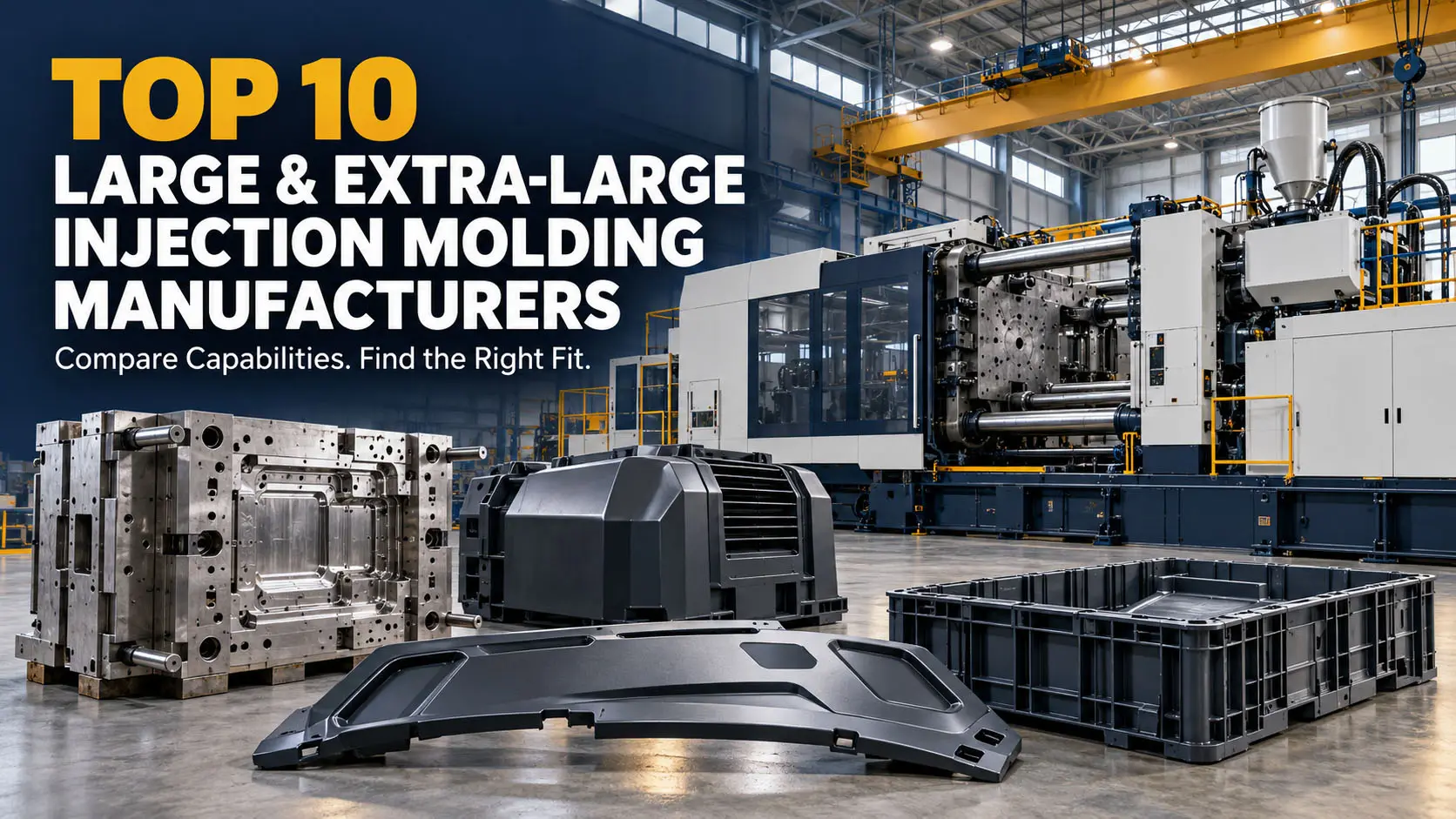
Table of Contents

- What Is Large and Extra-Large Injection Molding?
- Quick Comparison of 10 Large-Part Injection Molding Manufacturers
- 1. Bemis Contract Group — Large Components with Integrated Operations
- 2. EVCO Plastics — Large-Part Production Across Multiple Regions
- 3. Mack Molding — Large Parts with Cosmetic and Assembly Requirements
- 4. 20/20 Custom Molded Plastics — High-Pressure and Structural Foam Options
- 5. Ferriot — Large Enclosures with Finishing and Assembly
- 6. Rutland Plastics — UK Large-Part and Thick-Section Manufacturing
- 7. SINO MOULD — Large-Part Tooling and Molding Infrastructure
- 8. KYODO — Large Resin Components for Machinery Applications
- 9. China Synergy Manufacturing Group — Large Parts with Additional Manufacturing Support
- 10. Yijiang Technology — Custom Large-Part Molding and Mold Development
- The Four Checks That Matter More Than a Maximum Tonnage Number
- A Better Way to Compare Large-Part Quotations
- One Large Component or Several Smaller Components?
- What to Send with a Large-Part Injection Molding RFQ
- Frequently Asked Questions
- What is the difference between large-part and high-volume injection molding?
- Does a larger injection molding machine guarantee a larger part?
- Which manufacturer is best for extra-large plastic parts?
- Can large injection-molded parts have tight tolerances?
- What should I check before moving an existing large mold?
- Should I source large molded parts locally or overseas?
- Discuss Your Large Plastic Part with Yijiang


A large plastic component can be easy to describe and difficult to manufacture.
An equipment housing must fit its mating assembly. An exterior panel must maintain an acceptable appearance across a broad surface. A logistics container must survive handling while remaining economical to ship.
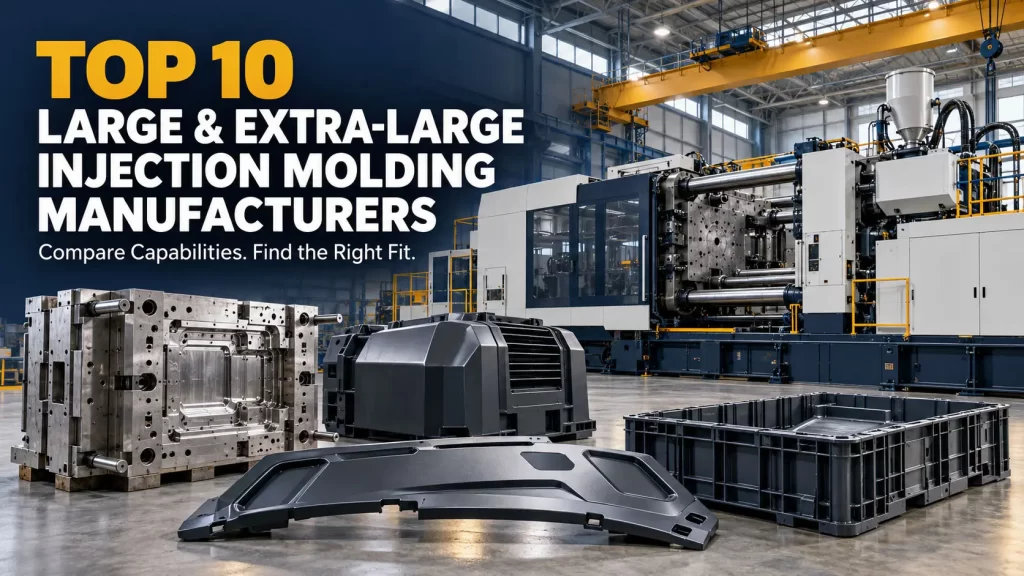
Finding the right large-part injection molding manufacturer therefore requires more than comparing maximum machine tonnage. Tool dimensions, shot capacity, material behavior, finishing, and handling all influence whether a supplier can deliver your part consistently.
This guide compares 10 manufacturers with publicly described large-part molding capabilities and explains what to verify before committing to tooling.
The most useful first question is: “Which production machine, mold concept, and inspection plan would you propose for this specific part?”
Editorial disclosure: This guide is published by Yijiang Technology, which is included in the selection. “Top 10” refers to an editorial shortlist, not an independently audited global ranking. Companies were selected for their publicly described large-part molding services or equipment. Numbering is for navigation; project-fit recommendations are editorial assessments.
What Is Large and Extra-Large Injection Molding?
Large-part injection molding produces plastic components whose dimensions, projected area, weight, or tooling requirements demand a suitable combination of machine capacity and production infrastructure.
Typical project categories include equipment housings, vehicle panels, industrial covers, containers, and structural components.
For this guide, “extra-large” describes projects requiring additional attention to mold space, injection capacity, heavy tooling, or oversized-part handling. It is not a universal size or tonnage classification.
Machine manufacturers themselves specify clamping force, injection capacity, and mold space separately. A press may satisfy one requirement while failing another. ENGEL large-part equipment overview
Quick Comparison of 10 Large-Part Injection Molding Manufacturers
The figures below reflect supplier-published information reviewed for this guide. They are not independently verified equipment audits or guarantees of available production capacity.
Units follow each source. “Tons” and “tonnes” should not be assumed identical; request clamping force in kN when comparing quotations.
| Manufacturer | Published large-part capability | Project focus to investigate |
|---|---|---|
| Bemis Contract Group | Presses up to 6,600 tons | Large components with assembly and finishing |
| EVCO Plastics | Large-tonnage machines from 1,000–4,400 tons | Programs requiring international production options |
| Mack Molding | Large-part press fleet from 1,500–4,000 tons | Cosmetic components and integrated assemblies |
| 20/20 Custom Molded Plastics | High-pressure presses up to 6,750 tons | Projects comparing high-pressure and structural foam routes |
| Ferriot | Presses up to 2,250 tons | Engineered enclosures and finished products |
| Rutland Plastics | Published installation of a 2,400-tonne machine | UK sourcing for large and technically demanding components |
| SINO MOULD | Large-part molding machines from 1,150–4,000 tons | Tooling-intensive large-part programs |
| KYODO | Company brochure describes a 4,000-ton injection molder | Large resin components for machinery applications |
| China Synergy Manufacturing Group | Published production capacity on presses up to 4,600 tons | Large components with additional manufacturing services |
| Yijiang Technology | Large-part molding and mold development services | China-based sourcing for custom oversized plastic parts |
Sources and project-specific considerations appear in the profiles below.
1. Bemis Contract Group — Large Components with Integrated Operations
Bemis Contract Group describes a large-part manufacturing operation with more than 80 injection molding presses, including equipment up to 6,600 tons. Its published capabilities include multi-barrel equipment, robotic machine attendance, large-part assembly, and secondary operations. Official large-part molding capabilities
Potential project fit: Large components that need molding, joining, decoration, or assembly coordinated within one manufacturing program.
What to verify: Identify the proposed production site and machine, then request a process map covering the operations required after molding.
Question to ask: “Which finishing and assembly steps are included in your quotation, and how will you inspect the completed component?”
2. EVCO Plastics — Large-Part Production Across Multiple Regions
EVCO Plastics publishes a fleet of more than 35 large-tonnage injection molding machines ranging from 1,000 to 4,400 tons across facilities in the United States, Mexico, and China. Its large-part offering also includes gas assist, insert molding, and secondary operations. Official large-parts services
Potential project fit: Programs where manufacturing location, regional supply, and secondary operations are important sourcing considerations.
What to verify: Confirm which capabilities are available at the specific facility proposed for your project.
Question to ask: “Which site would manufacture this part, and what qualification work would be needed if production moved to another facility?”
3. Mack Molding — Large Parts with Cosmetic and Assembly Requirements
Mack Molding lists a large-part press fleet ranging from 1,500 to 4,000 tons. Its published services include engineering support, robotic handling, gas-assisted molding, and post-molding operations. Its Inman facility also describes automated painting and assembly capabilities. Large-part molding · Inman facility
Potential project fit: Large visible housings or panels that require coordinated molding, appearance control, and assembly.
What to verify: Establish acceptance criteria for the final surface, including any painted or decorated finish.
Question to ask: “Will appearance approval be based on molded samples, finished samples, or both?”
4. 20/20 Custom Molded Plastics — High-Pressure and Structural Foam Options
20/20 Custom Molded Plastics publishes high-pressure injection molding capacity up to 6,750 tons. It also offers low-pressure structural foam, structural web, and gas-assist processes. Official high-pressure molding capabilities
Potential project fit: Large components for which different molding processes deserve evaluation before tooling is commissioned.
What to verify: Request the reasons for the proposed process, including appearance, wall design, dimensional requirements, and tooling economics.
Question to ask: “Would you evaluate this design using both high-pressure molding and a structural foam route, and explain the trade-offs?”
5. Ferriot — Large Enclosures with Finishing and Assembly
Ferriot describes large-part injection molding using presses up to 2,250 tons, alongside structural foam and gas-assist processes. Its broader services include engineering, painting, shielding, decorating, and assembly. Official manufacturing capabilities
Potential project fit: Equipment housings and enclosures that require several manufacturing operations before delivery.
What to verify: Separate the dimensional requirements of the molded component from the acceptance requirements of the finished assembly.
Question to ask: “How will coating, joining, and assembly operations be accounted for in the inspection plan?”
6. Rutland Plastics — UK Large-Part and Thick-Section Manufacturing
Rutland Plastics describes large-part and thick-section molding expertise, supported by tooling and secondary operations. Its current company material reports the installation of a 2,400-tonne ENGEL machine. Official company website · Large-part molding discussion
Potential project fit: Buyers evaluating UK production for large components or designs involving substantial sections.
What to verify: Ask for material-specific guidance rather than applying a published maximum size or weight to every project.
Question to ask: “What design changes would improve cooling, internal quality, and dimensional stability for this material?”
7. SINO MOULD — Large-Part Tooling and Molding Infrastructure
SINO MOULD describes large-part molding equipment ranging from 1,150 to 4,000 tons, together with large machining equipment and heavy lifting infrastructure. Its offering combines tooling and large-part molding support. Official large-part molding services
Potential project fit: Projects where mold development, machining capacity, and production trials are central to supplier selection.
What to verify: Clarify whether the quotation covers an export mold, molding trials, ongoing part production, or a combination of these services.
Question to ask: “Who is responsible for mold trials and final acceptance, and where will volume production take place?”
8. KYODO — Large Resin Components for Machinery Applications
KYODO’s English company profile describes a 4,000-ton injection molder and large resin components, including applications involving industrial machinery and vehicles. Its product portfolio also covers construction and agricultural machinery components. Official company profile · Product overview
Potential project fit: Machinery components being evaluated for plastic construction or integration with other manufactured parts.
What to verify: Confirm current equipment availability and experience with comparable service conditions.
Question to ask: “Which material and validation approach would you propose for the loads and environment this component will experience?”
9. China Synergy Manufacturing Group — Large Parts with Additional Manufacturing Support
China Synergy Manufacturing Group publishes injection molding production capacity on presses up to 4,600 tons. Its production page also lists finishing, packaging, electromechanical assembly, and other molding options. Official production capabilities
Potential project fit: International sourcing programs combining large molded components with additional operations.
What to verify: Identify the actual production facility, equipment allocation, and responsibilities for any outsourced work.
Question to ask: “Which operations will be performed at the proposed molding facility, and which will be handled elsewhere?”
10. Yijiang Technology — Custom Large-Part Molding and Mold Development
Yijiang Technology offers large and extra-large injection molding services alongside custom mold development. Its published service scope includes project evaluation, mold design, molding, inspection, and post-molding handling for oversized components. Yijiang large-part injection molding services
Potential project fit: Buyers evaluating a China-based manufacturing partner for large plastic housings, panels, and other custom components.
What to verify: Request a project-specific machine and tooling proposal, including confirmed capacity, manufacturing location, and inspection arrangements.
Question to ask: “Based on our CAD model and material, which machine would you use, and what are the main feasibility risks?”
Projects requiring new tooling can also be discussed through Yijiang’s mold design and development service.
The Four Checks That Matter More Than a Maximum Tonnage Number
A useful large-part feasibility review should answer four separate questions.
1. Can the Machine Keep the Mold Closed?
Clamping requirements depend on projected area and molding conditions. Part weight alone does not establish the required clamping force.
Ask the supplier to document how the proposed machine was selected for your geometry and material.
2. Can the Injection Unit Deliver the Required Shot?
The injection unit must supply the required amount of material for the proposed tool and process.
Ask whether quoted shot capacity is a volume or a reference-material weight, and how it applies to your selected resin.
3. Will the Mold Fit and Operate?
Mold dimensions, tie-bar spacing, opening requirements, and part-removal clearance must be compatible with the press.
Ask for a machine-and-mold compatibility review before the mold design is finalized.
These are separate capacity checks: clamping force, shot capacity, and mold space should be reviewed together. 20/20’s published machine-selection guidance
4. Can the Factory Handle the Tool and Part?
Large-part production also needs suitable lifting, handling, and downstream space. For example, SINO MOULD specifically lists heavy lifting and large machining infrastructure within its large-part offering. Published infrastructure
Request a handling plan covering mold installation, part removal, inspection, and packaging.
A Better Way to Compare Large-Part Quotations
Ask every shortlisted manufacturer to quote against the same drawing revision, resin specification, annual volume, and acceptance criteria.
Then compare the following items:
| Quotation item | What should be explicit |
|---|---|
| Mold investment | Tool specification, ownership, maintenance, and change costs |
| Production assumptions | Proposed machine, cavity count, order quantity, and cycle assumptions |
| Validation | Sampling stages, inspection reports, and approval responsibilities |
| Secondary operations | Trimming, painting, joining, inserts, or assembly |
| Packaging | Protection method, nesting arrangement, and units per shipping pack |
| Delivery | Destination, shipment size, and quoted delivery terms |
| Continuity | Available backup capacity and tooling-transfer arrangements |
For bulky components, compare the delivered cost per accepted part—not just the molding price.
Consider a hypothetical delivery cost of $2,400:
- At 120 parts per shipment, delivery costs $20 per part.
- At 240 parts per shipment, delivery costs $10 per part.
The arithmetic illustrates why packaging density deserves early attention. It does not mean every component can safely be nested more closely: appearance, deformation, handling, and damage risks still need evaluation.
One Large Component or Several Smaller Components?
Before approving an extra-large mold, ask suppliers to compare two design routes:
Route A: One integrated molded component
Evaluate the larger mold and machine requirements against the opportunity to reduce assembly operations.
Route B: Several molded components joined afterward
Evaluate smaller tooling and production options against the additional joints, assembly work, and inspection requirements.
The right decision depends on the product. Ask for an explicit comparison of:
- Tooling investment.
- Functional and dimensional requirements.
- Appearance and joint visibility.
- Assembly cost.
- Packaging and transport.
- Repair or replacement needs.
This review can reveal whether “extra-large injection molding” is a necessary requirement or simply one possible manufacturing route.
What to Send with a Large-Part Injection Molding RFQ
A useful request for quotation should include:
- A 3D CAD model and controlled 2D drawing.
- Overall dimensions and estimated part weight.
- Resin grade or clearly defined performance requirements.
- Critical dimensions, mating interfaces, and assembly details.
- Visible surfaces and cosmetic acceptance criteria.
- Initial order quantity and expected annual demand.
- Required inserts, finishing, or secondary operations.
- Target sample and production dates.
- Delivery destination and packaging constraints.
- Existing mold information, if transferring production.
Ask each supplier to return assumptions, exclusions, and unresolved technical questions alongside the price.
Frequently Asked Questions
What is the difference between large-part and high-volume injection molding?
Large-part molding concerns the physical component and the equipment needed to produce it. High-volume molding concerns production quantity. A manufacturer producing millions of small parts may not have equipment suitable for an oversized housing.
Does a larger injection molding machine guarantee a larger part?
No. Mold space and injection capacity must also be suitable. Confirm the proposed machine against the actual mold and material requirements instead of relying on maximum tonnage alone.
Which manufacturer is best for extra-large plastic parts?
The strongest candidate is the supplier that can demonstrate a suitable production plan for your design. Use the shortlist to identify candidates, then compare written feasibility reviews, relevant project evidence, and equivalent quotations.
Can large injection-molded parts have tight tolerances?
Critical dimensions should be reviewed individually. Ask the manufacturer to assess the resin, geometry, dimension length, tooling, and measurement conditions rather than accepting a blanket tolerance claim for the entire component.
What should I check before moving an existing large mold?
Confirm tool ownership, condition, documentation, and compatibility with the receiving factory’s machines. Agree on transportation, inspection, refurbishment, trials, and production approval before initiating the transfer.
Should I source large molded parts locally or overseas?
Compare complete delivered costs and operational requirements. Tooling, part price, shipping density, delivery frequency, inventory, communication, and supplier access can all affect the decision. Request equivalent quotations for the same scope.
Discuss Your Large Plastic Part with Yijiang
A productive supplier conversation starts with your part requirements.
Send Yijiang your CAD files, material specification, expected quantity, critical dimensions, and delivery needs to discuss a project-specific manufacturing approach.
- PREV: Null
- NEXT: Null

Yijiang is a professional custom manufacturing partner specializing in large-scale injection molding and precision mold development. We support global clients in automotive,
in large-scale injection molding and precision mold development. We support global clients in automotive,


Get a quote from the China’s #1 CNC Machining Services.
Ready to get started? Connect with us today!
 Talk to Our Team