Plastic Injection Mold Manufacturer for Engineering Plastics


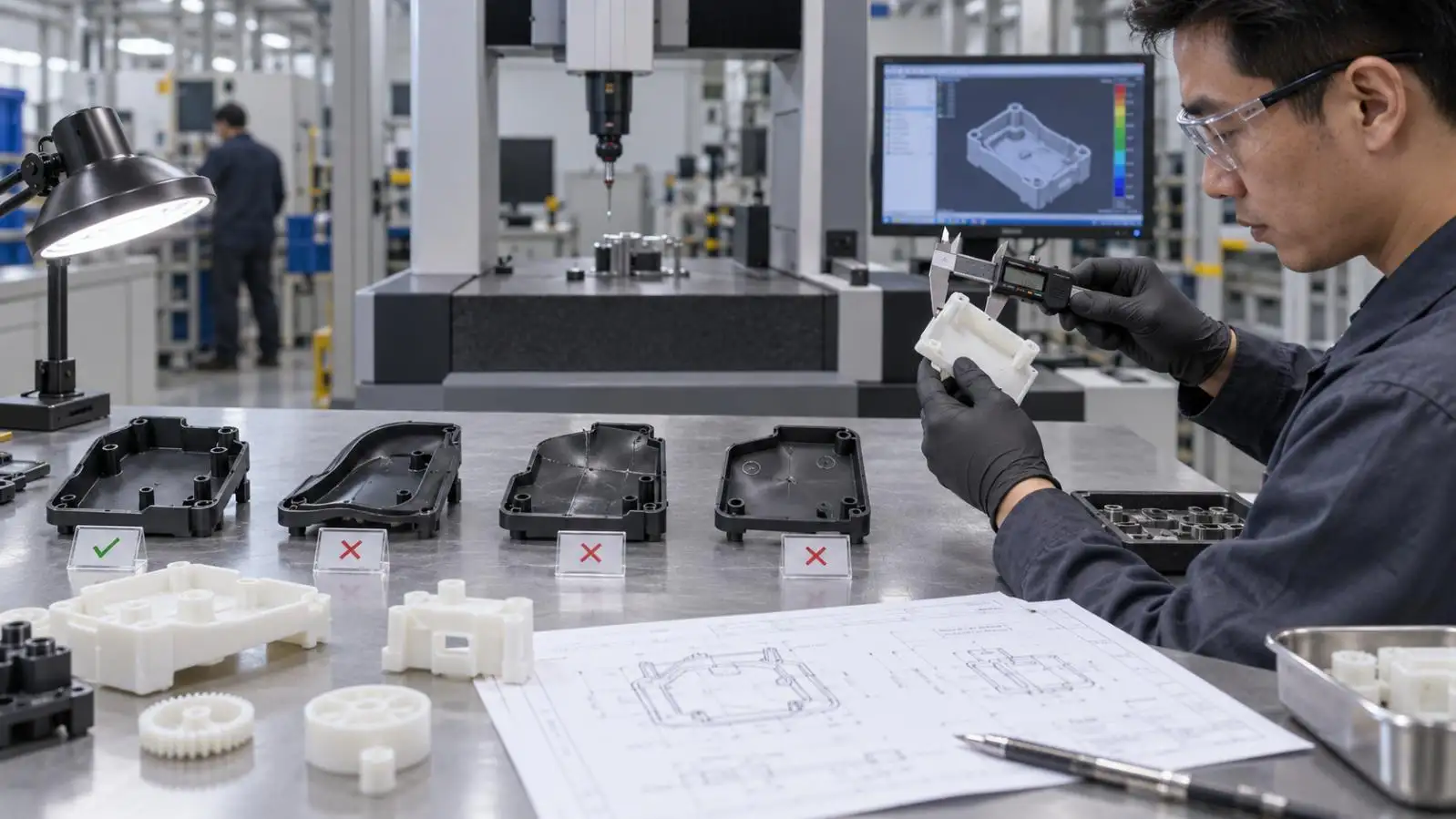

An engineered plastic component can change after molding due to numerous factors including moisture absorption, residual stress, fiber orientation, and post-molding shrinkage. These can all impact the performance of the component.
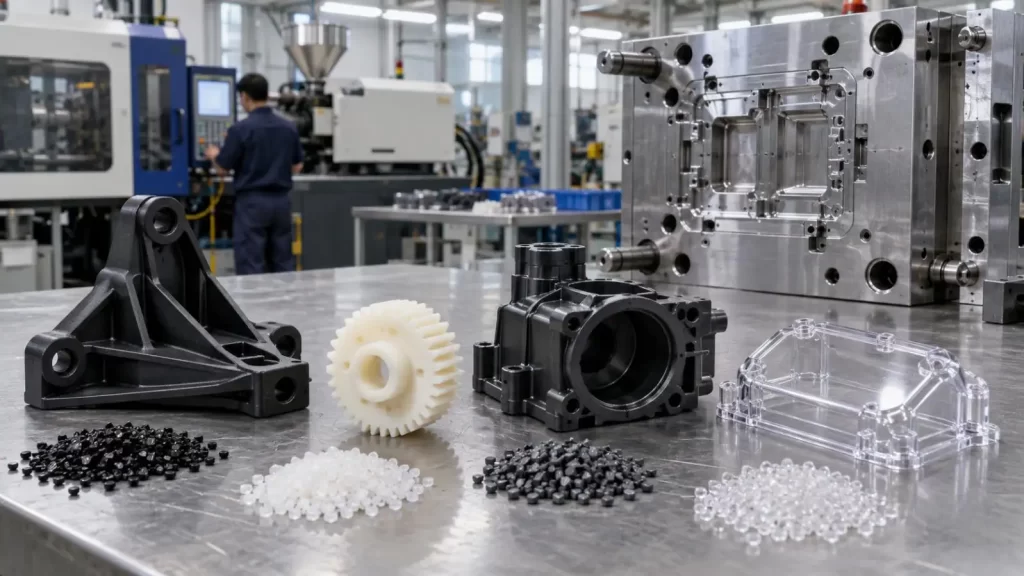
At Yijiang, as a Plastic Injection Mold Manufacturer, our strategy links material choice, mold design, machining, and trial verification to establish tooling conditions that would enable us to make functional parts.
Start With the Resin Grade and Service Conditions
"PA66" or "PBT" is insufficient information for final tooling decisions. Reinforcement, flame retardants, lubricants, and other additives can change flow behavior, wear, and dimensional response.
A Plastic Injection Mold Manufacturer needs the complete resin designation alongside the component's operating requirements.
| Material | Application Objective | Critical Tooling Considerations | Validation Focus |
| PA / Glass-Filled PA | Strength and structural stiffness | Fiber orientation, directional shrinkage, wear | Dimensions and function at specified moisture conditions |
| PBT | Electrical and precision components | Crystallization, gate location, cooling balance | Warpage and dimensional repeatability |
| POM | Gears, guides, sliding components | Shrinkage, venting, residence-time control | Fit, friction, and dimensional stability |
| PC | Impact-resistant or transparent housings | Flow resistance, surface finish, stress control | Appearance and assembly performance |
| PPS / PEEK | Demanding thermal or chemical service | High-temperature tooling and equipment compatibility | Grade-specific processing and service testing |
PPS and PEEK illustrate specialized requirements; their inclusion does not establish Yijiang's processing capability for a particular grade.
Five Tooling Decisions That Determine Part Performance
1. Select Tool Steel Around Wear, Corrosion, and Repair
Glass-filled resins can accelerate wear at gates, runner transitions, and shut-off surfaces. Corrosion resistance requires separate consideration for relevant resin and additive systems.
This review will determine the following for our tooling:
• Expected cycles and maintenance intervals, production demand
• Wear exposure: Type of filler, method of loading, and local flow conditions
• Surface requirements: Polishing, texture, and wear marks
• Serviceability: Replaceable inserts and access to vulnerable features
It can be worth the cost for a more expensive steel if the service-life benefit justifies the cost of downtime and repairs.
2. Position Gates Around Loading and Flow
Gate placement influences weld lines, fiber orientation, packing, and shrinkage. For a reinforced mounting bracket, the critical question is whether the resulting flow pattern supports loads around holes, ribs, and attachment points.
A Plastic Injection Mold Manufacturer should consider:
• Where weld lines will form relative to stressed features.
• Packing access occurring before the gate freezes.
• Pressure loss along the flow path.
• Directional shrinkage due to fiber alignment.
CAE predictions are only as good as the assumptions made for the material and the processing. Trial parts will confirm the design.
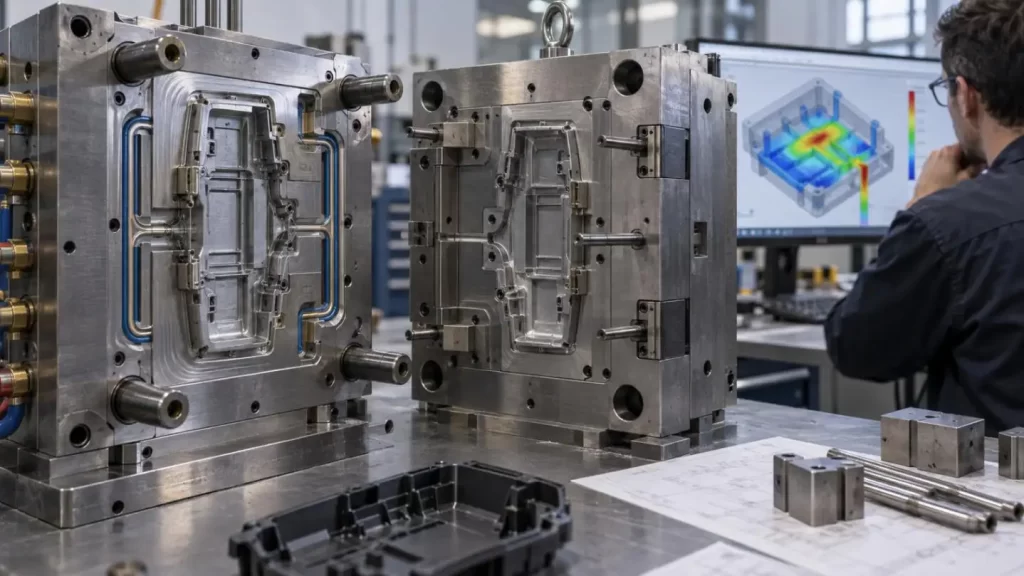
3. Design Thermal Control for Uniformity
The cooling cycle is not simply about achieving the shortest possible cooling times.
There can be uneven shrinkage in a part due to temperature gradients in the cavity, cores, and thick sections. Semicrystalline materials also need to consider the Behavior of Crystallization.
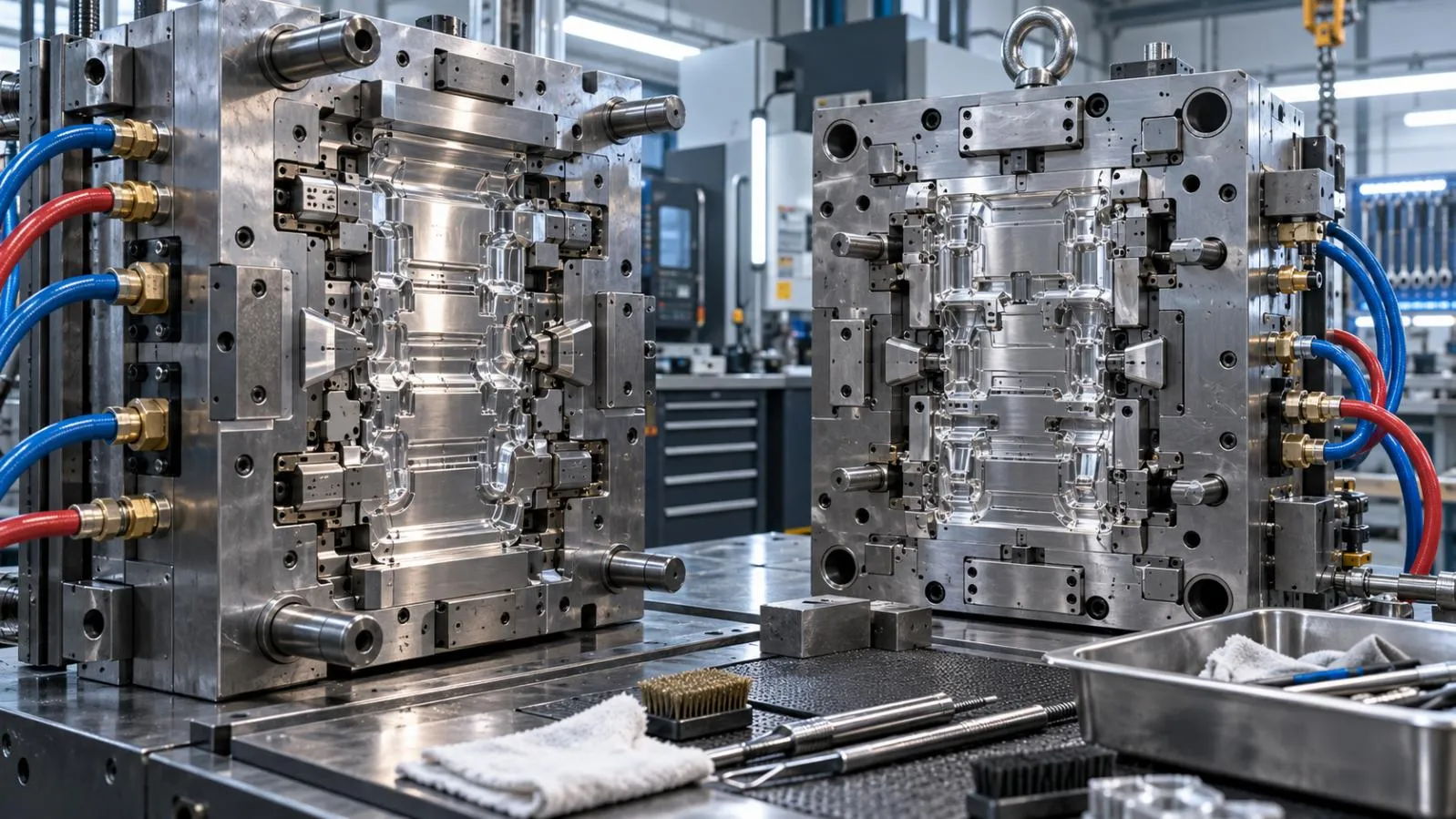
Review the circuit layout, flow restrictions, and insert interfaces. Consider conformal cooling and analyze the tradeoffs between the costs of fabrication and maintenance compared to traditional cooling.
4. Define Dimensions Under Agreed Conditions
Mold machining accuracy does not equal molded-part capability.
Shrinkage of reinforced resins can be different in the flow and across the flow directions. Moisture absorption can also cause further changes in PA dimensions after processing.
Before steel cutting:
• Establish critical-to-quality dimensions and functional datums.
• Determine the timing of measurements post molding.
• Establish the conditioning temperature and relative humidity.
• Determine the inspection method and reveal fixtures.
• Indicate features which require an adjustment allowance during trial assembly.
A Plastic Injection Mold Manufacturer should document these conditions before dimensional approval.
5. Coordinate Venting and Ejection
Vents must release displaced air without allowing unacceptable flash. Their dimensions depend on the resin and process.
Ejection requires similar coordination. Insufficient draft, rough surfaces, or concentrated ejector force can damage a component that otherwise fills correctly.
Assess ejector placement against local stiffness and the part's temperature at release.
Diagnose Defects Before Modifying Steel
The same defect can have several causes. Tool changes should follow evidence from material condition, process settings, and inspection.
| Symptom | Process or Material Checks | Tooling Checks |
| Warpage | Packing, fiber orientation, shrinkage | Gate layout, thermal balance |
| Progressive flash | Pressure, viscosity, clamping | Parting-line wear, support |
| Weld-line weakness | Temperature, material condition | Flow convergence, venting |
| Dimensions drifting in storage | Moisture, post-shrinkage | Compensation and feature design |
| Ejection distortion | Release temperature, stiffness | Draft, ejector distribution |
This diagnostic discipline helps a Plastic Injection Mold Manufacturer avoid repeated corrections that address symptoms alone.
How Yijiang Connects Design With Toolmaking
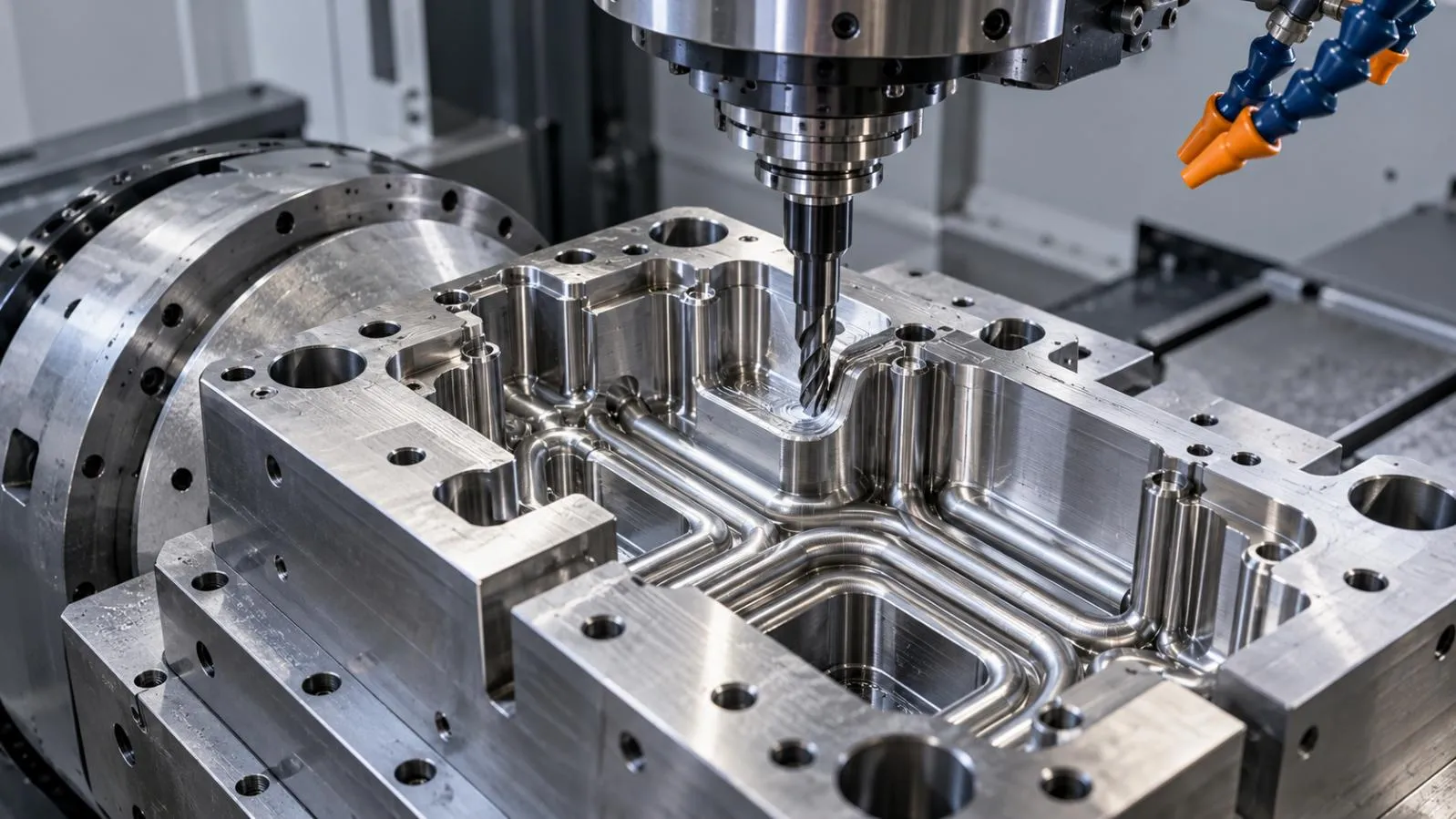
We use 3D CAD, CAE mold-flow analysis, CNC machining, EDM, assembly trials, and inspection in our process. We can also provide traced materials for cores and cavities.
Our tooling options can be tailored to your project needs:
| Tooling Type | Main Advantage | Engineering Trade-Off |
| Hot Runner Mold | Less runner waste | Thermal sensitivity and maintenance complexity |
| Cold Runner Mold | Simpler runner system | Runner consumption and handling |
| Insert & Overmold Mold | Functional components positioning and material-interface control | Limited life and production volume |
| Rapid Tooling | Design evaluation | Limited life and production volume |
| Production Tooling | Sustained production | Higher initial cost |
These are our custom tooling categories; our referenced page does not provide model numbers of traditional products.
Take Production Evidence Into Account When Evaluating Quotes
When selecting a Plastic Injection Mold Manufacturer, to consider among others, the service conditions and the annual volume, the acceptance criteria, and the CAD should be considered.
When a quote request is made, be sure to include among others, the engineering-change costs, the scrap, the maintenance costs, and the cycle time. Send the initial quote, if any, to the recipients of the request.
Once a sample has been approved, it does not ensure repeatability for production.
For your next engineering plastic component, Yijiang's mold design and development services offer the opportunity to evaluate material, tooling, and production system options.
FAQs
Q1. What Mold Design and Manufacturing Services Does Yijiang Offer?
Yijiang provides 3D CAD design, CAE mold-flow analysis, CNC machining, EDM, surface finishing, assembly, trial runs, and inspection. Its services support both prototype development and production tooling.
Q2. Can Yijiang Develop Molds for Engineering Plastic Components?
Yijiang develops custom molds around material, geometry, and production requirements. Share the complete resin grade, reinforcement content, operating conditions, and critical dimensions so its engineers can assess tooling suitability for your application.
Q3. What Types of Injection Molds Does Yijiang Manufacture?
Yijiang lists two-plate molds, three-plate molds, hot runner molds, cold runner molds, and insert and overmolding tools. It also offers rapid tooling and production tooling for different development stages and volume requirements.
Q4. Does Yijiang Provide DFM and Mold Flow Analysis?
Yes. Yijiang lists DFM analysis and CAE mold-flow simulation within its development capabilities. These reviews help identify design and filling risks before machining, while trial runs verify the resulting tooling.
Q5. How Does Yijiang Select Mold Materials?
Yijiang selects tool steel, aluminum, or specialized alloys according to production volume, part complexity, and expected mold life. Buyers should also specify resin fillers and surface requirements because these influence wear and finishing needs.
- PREV: Null
- NEXT: Null

Yijiang is a professional custom manufacturing partner specializing in large-scale injection molding and precision mold development. We support global clients in automotive,
in large-scale injection molding and precision mold development. We support global clients in automotive,


Get a quote from the China’s #1 CNC Machining Services.
Ready to get started? Connect with us today!
 Talk to Our Team