Large Mold Injection Molding Design Guidelines: DFM Considerations for Large Parts

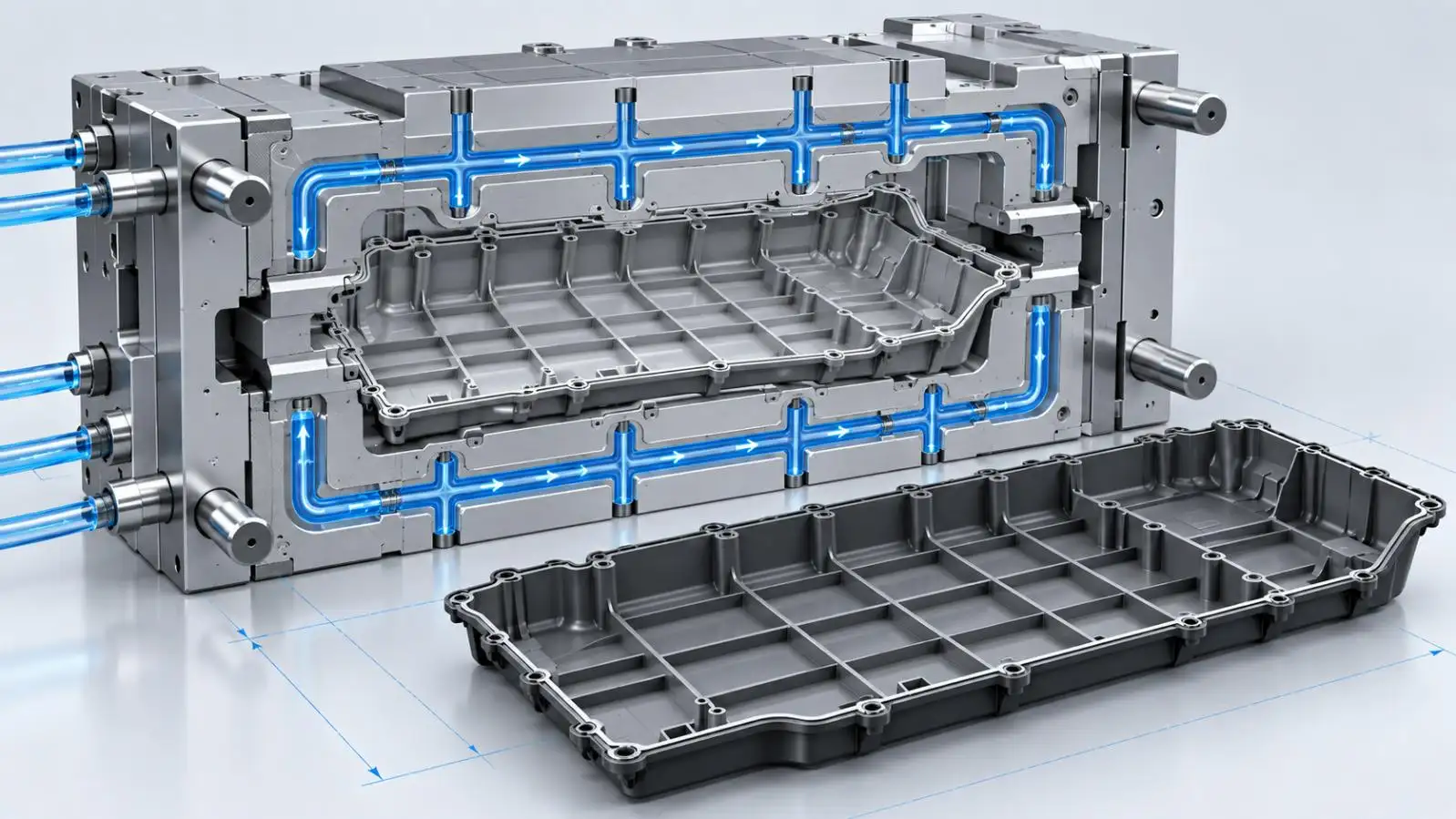
Table of Contents

- The Importance of DFM for Large Mold Injection Molding Projects
- Unique Considerations for Large Mold Injection Molding
- 1. Design for Large Part Stability - Wall Thickness Design
- 2. Mold Flow Analysis - Perceiving Large Part Filling (How Large Parts Fill)
- 3. Gate and Runner Design for Large Injection Molding
- 4. Cooling System Optimization: Controlling Warpage and Cycle Time
- 5. Material Selection for Large Plastic Components
- Common Large Mold Injection Molding Defects and Remedies
- Yijiang's Engineering Approach to Large Mold Injection Molding


The Importance of DFM for Large Mold Injection Molding Projects
Increasing automotive electrification and the development of lightweight structures and industrial equipment have increased the demand for Large Mold Injection Molding for the production of oversized components in plastic. Large mold injection components present more challenges for mold design due to changes in size, weight, complexity, and demands for more precise tolerances.
At Yijiang, we believe that Large Mold Injection Molding requires a different perspective, beyond the conventional view of large molding. Designing and producing large plastic components requires analysis of DFM (Design for Manufacturing), optimization of mold structure, evaluation and selection of materials, and control of the manufacturing process.
Designing large plastic components is not only about the question of—"Can the machine mold this part?"—but also, "Can this large component be designed and manufactured to ensure consistency in filling, cooling and other molding requirements?"
Unique Considerations for Large Mold Injection Molding
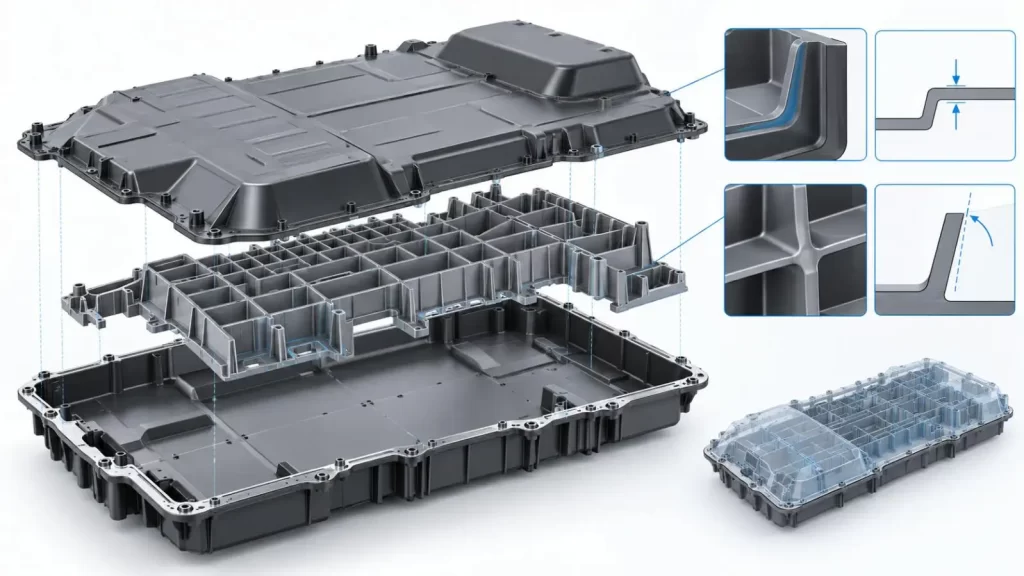
Typically, Large Mold Injection Molding is used for larger, more complex components or for components that require a larger volume of material, such as:
• Automotive exterior panels, such as fenders and roof panels
• Battery covers and structures
• Large equipment housings
• Components for large appliances
• Logistics and storage equipment components
• Large components for industrial equipment and machinery
Compared to standard injection molding, large and complex components require more extensive engineering effort.
| Evaluation Factor | Standard Injection Molding | Large Mold Injection Molding |
| Part size | Small and medium components | Large structural components |
| Mold structure | Conventional tooling | High-strength large-scale molds |
| Filling behavior | Short flow distance | Long flow path and pressure loss |
| Cooling control | Relatively simple | Complex thermal management |
| Main risks | Basic defects | Warpage, shrinkage, deformation, dimensional variation |
Large Mold Injection Molding requires coordination between product design, mold engineering, injection parameters, and quality inspection.
1. Design for Large Part Stability - Wall Thickness Design
Wall thickness influences some important aspects of large molded parts including:
• Melt flow
• Uniformity of cooling
• Behaviour of shrinkage
• Mechanical strength
• Cycle time of production
Many beginners think the strength and wall thickness of a given part are positively correlated. Although wall thickness is important, adding too much will generate internal stress caused by non-uniform cooling.
DFM for Wall Thickness Design
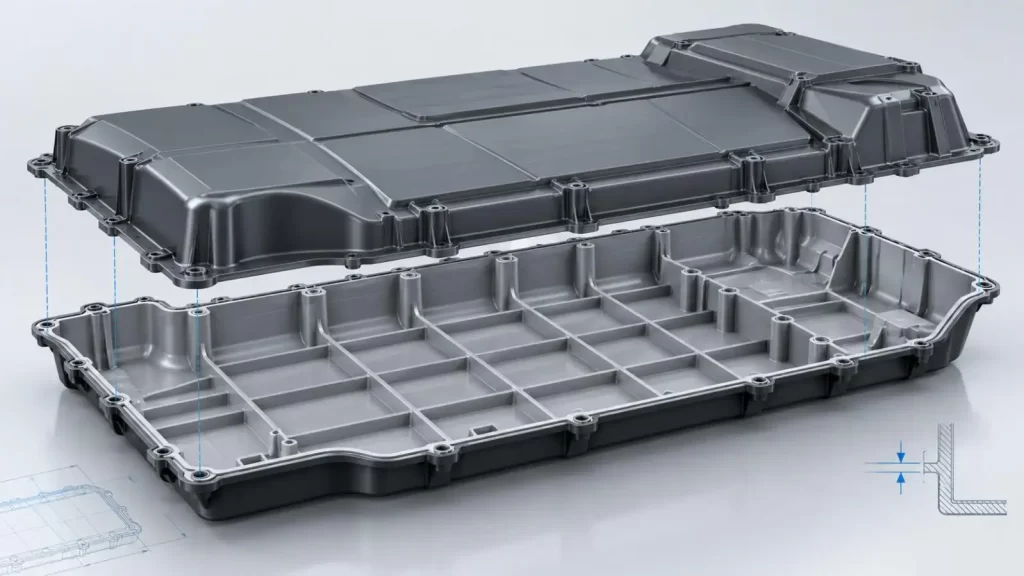
• Try to maintain the same wall thickness where possible.
• Try to keep wall thickness consistent.
• Consider using multiple ribs and/or strengthening elements, instead of adding additional wall thickness, to provide a more dense part.
• When designing the part consider material shrinkage that will occur during the fabrication process.
| Design Approach | Manufacturing Impact |
| Equal wall thickness | Reduces Pacific Shrinkage (shrinkage variation in one dimension) and warpage |
| Smooth wall thickness transitions | Improves flow stability |
| Rib reinforcement | Reduces weight and increases strength |
| Correct draft angle | Easy ejection from mold |
The design features mentioned previously impact the complexity of the tooling as well as the final dimensional accuracy of large injection molded parts.
2. Mold Flow Analysis - Perceiving Large Part Filling (How Large Parts Fill)
Long melt flow paths (that are associated with large parts) lead to the following problems with more severity:
• Short Shots
• Weld lines
• Trapped Air
• Uneven filling pressures
• Localized deformation
Before tooling is made, engineers assess the following in order from most to least important:
• Filling sequence
• Injection press distribution
• Gate placement
• Balance of cooling
• Possible warpage
In large mold injection, the typical flow order is:
Product Design Review
↓
DFM Analysis
↓
Mold Flow Simulation
↓
Mold Manufacturing
↓
Trial Molding Optimization
↓
Mass Production
This process identifies possible problems needing tooling changes.
3. Gate and Runner Design for Large Injection Molding
For large parts, gate design influences appearance, strength, and dimensional stability.
Incorrect gate placement provides the following concerns:
• Gaps in fill
• Mark/stain visible on surface
• Weak zone formation
• High injection pressure
Main design features include:
| Component shown | Function |
| Multi-point gating | Equalized filling of large area |
| Hot runner structure | Decreased material loss and greater control |
| Optimized runner size | Decreased loss of pressure |
| Gate location analysis | Improved surface finish |
Large scale injection molding projects at Yijiang are examined from both the mold structure and production processes for determining the tooling design that best accommodates the manufacturing process.
4. Cooling System Optimization: Controlling Warpage and Cycle Time
In Large Mold Injection Molding, a fetal element is cooling design.
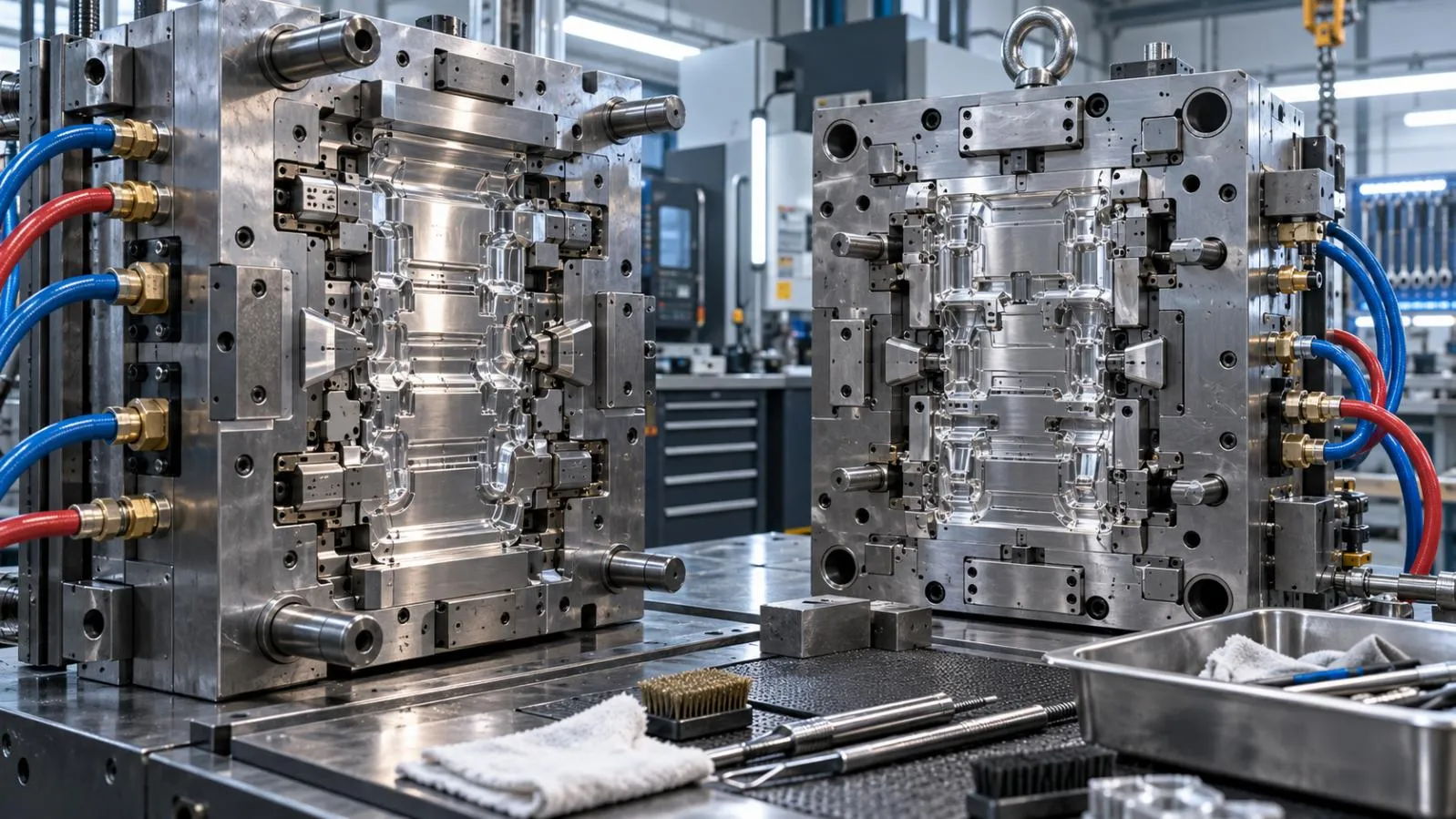
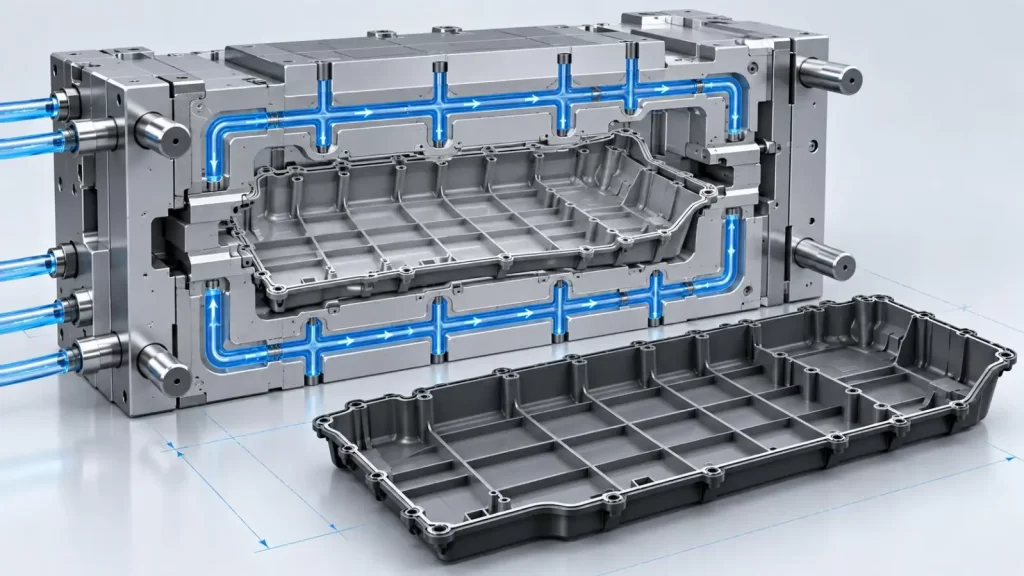
Components in this size range feature thicker walls and larger surfaces, which leads to uneven cooling. The results of uneven cooling lead to longer cycle times, higher rejection rates and part deformations that become unstable. An efficient cooling design may include:
• Balanced cooling channels
• System for removing heat from the mold
• Accounting for the shrinkage of molded materials
• Design simulations for optimizing design
An optimal cooling system will provide constant geometry for all injection molded parts in a mass production situation.
5. Material Selection for Large Plastic Components
The final application dictates the selection of materials.
Main materials used in Large Mold Injection Molding include:
| Material Characteristics | Typical Applications |
| PP Lightweight, chemical resistance | Automotive parts, battery covers |
| ABS Good appearance and impact resistance | Equipment housings |
| PC/ABS Strength and balance of surface quality | Industrial covers |
| PA + Glass Fiber High mechanical performance | High performance applications |
Considerations include:
• Temperature
• Chemical exposure
• Load
• Appearance
• Durability
The right material selection eliminates risks during the manufacturing process and improves the performance of the product throughout its lifecycle.
Common Large Mold Injection Molding Defects and Remedies
| Defect | Cause | DFM Solution |
| Warpage | Uneven cooling or shrinking | Optimize cooling channels and wall thickness |
| Sink marks | Excess thickness | Fine rib structure |
| Short shot | Poor filling balance | Adjust gate and runner positioning |
| Flash | Excessive pressure or rigidness of mold | Flash is typically caused by insufficient Mold structure |
Corrections after the production process has begun are more expensive and time consuming than the design phase corrections for large component defects.
Yijiang's Engineering Approach to Large Mold Injection Molding
Yijiang focuses on comprehensive integrated Large Mold Injection Molding services covering mold design, manufacturing, and large scale production.
For large and extra-large injection molding, Yijiang offers:
• Large mold injection machines
• Custom mold design and manufacture
• Engineering driven DFM
• Production quality control
For large injection molding, Yijiang has:
| Parameter | Value |
| Max clamp force | 5500 Tons |
| Max molded part length | 2500 mm |
| Part weight | 5–120 Kg |
| Molding precision | ± 0.02 mm |
| Manufacturing facility | 10,000 m² |
These capacities allow Yijiang to serve automotive, new energy, and other industrial equipment sectors and cover large plastic component markets.
Conclusion: Engineering is the Key to Success of Large Mold Injection Molding
Large Mold Injection Molding is much more than using a bigger injection molding machine. It’s about the engineering process as a whole and how everything from DFM and molding design to materials, cooling, and quality control are integrated.
For companies molding oversized parts, early collaboration with an experienced manufacturer is a good way to move molding from risk to stability.
Yijiang's Large Mold Injection Molding engineering based services take care of large molding from initial design evaluation to large-volume manufacturing. For more information on Yijiang's large and extra-large injection molding services, please go here.
FAQs
Q1. What is Large Mold Injection Molding?
Large Mold Injection Molding is an injection molding process designed for producing oversized plastic components that require large molds, higher clamping force, and advanced process control. It is commonly used for automotive parts, industrial housings, and new energy components.
Q2. What types of large parts can Yijiang manufacture with Large Mold Injection Molding?
Yijiang supports the production of large plastic components such as automotive exterior parts, battery-related components, industrial equipment housings, and other oversized injection molded products requiring stable dimensions and structural performance.
Q3. What injection molding capacity does Yijiang provide for large parts?
Yijiang’s large and extra-large injection molding capability supports machines with clamping forces up to 5,500 tons, allowing production of oversized plastic components with large dimensions and complex structures.
Q4. What is the maximum part size Yijiang can handle?
Yijiang’s Large Mold Injection Molding solutions can support parts with a maximum length of approximately 2,500 mm, depending on product geometry, material requirements, and mold design.
Q5. How does Yijiang control dimensional accuracy for large injection molded parts?
Yijiang applies engineering control throughout the manufacturing process, including DFM analysis, mold optimization, process parameter management, and precision inspection. For precision applications, molding accuracy can reach approximately ±0.02 mm.
- PREV: Null
- NEXT: Null

Yijiang is a professional custom manufacturing partner specializing in large-scale injection molding and precision mold development. We support global clients in automotive,
in large-scale injection molding and precision mold development. We support global clients in automotive,


Get a quote from the China’s #1 CNC Machining Services.
Ready to get started? Connect with us today!
 Talk to Our Team