Injection Molded Parts Manufacturer Guide to Tight Tolerances and Process Capability

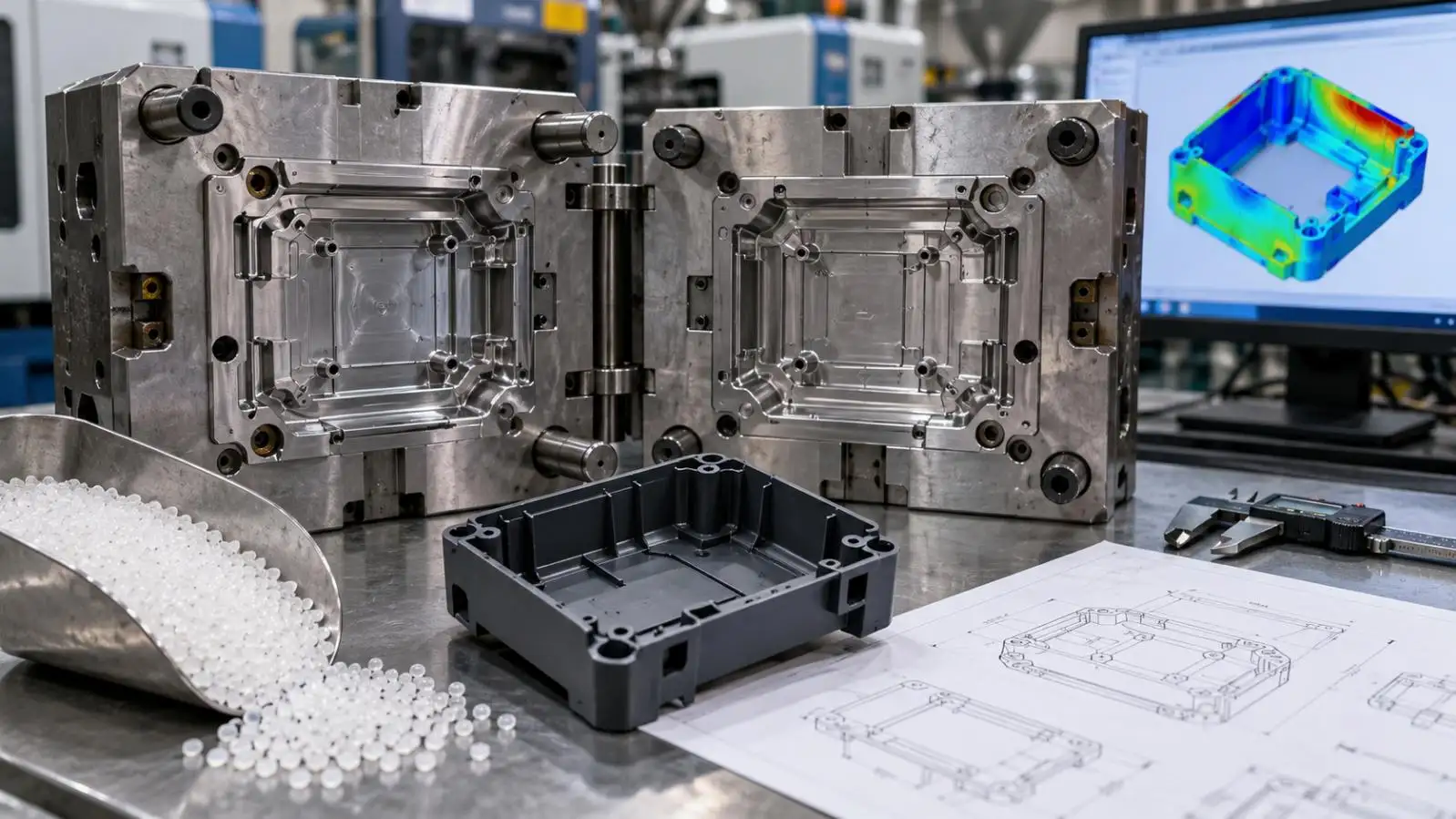
Table of Contents

- Assign Tolerances According to Functional Risk
- Yijiang's Manufacturing Process and Capacity
- Define Tight Tolerances Around Assembly Function
- Behavior of Material During Processing and Tool Design
- Understand Cp, Cpk, and Production Stability
- Verify Measurement Before Approving Production
- Balance Precision With Manufacturing Cost


A molded part may meet its drawing during sampling yet develop assembly problems during production. Hole spacing can shift between cavities, large panels can warp, and moisture-sensitive resins can change dimensions after molding.
Our integrated design, tooling and production service at Yijiang fill the need you have for a solution to these problems. Assessing injection-molded parts manufacturers requires an evaluation of the manufacturing resources alongside evidence for quality.
Tolerance defines acceptable dimensional variation. Process capability describes how a stable production process performs within those limits.
Assign Tolerances According to Functional Risk
Start With the Assembly
Before discussing achievable precision, identify which features locate, retain, seal, or support adjoining components.
An Injection Molded Parts Manufacturer needs more than isolated dimensions. Datum references, mating-part requirements, and tolerance accumulation determine whether individually acceptable parts assemble correctly.
| Feature | Functional Risk | Engineering Review |
| Locating holes | Misalignment or forced assembly | Position relative to functional datums |
| Snap-fit arms | Excessive insertion force or weak retention | Thickness, engagement, material stiffness |
| Sealing faces | Uneven compression or leakage | Flatness, warpage, mating geometry |
| Large housings | Interference or inconsistent gaps | Overall distortion and tolerance stack-up |
Tighten critical interfaces selectively. Applying the same narrow tolerance to every feature can increase tooling and inspection costs without improving function.
Yijiang's Manufacturing Process and Capacity
Yijiang combines product design, mold development, precision machining, injection molding, and post-processing. Our manufacturing data establishes a starting point for project assessment.
| Manufacturing Stage | Yijiang's Capacity | Engineering Significance |
| Production infrastructure | 10,000+ m² factory; 30+ injection molding machines | Supports equipment selection and production planning |
| Injection molding | 50–2500 tons clamping force | Accommodates different projected areas and tooling requirements |
| Injection pressure | 50–250 MPa listed range | Provides process context; actual settings depend on resin, geometry, and equipment |
| Molded-part precision | Tolerance capability of ±0.02 mm | Requires confirmation for specified features and measurement conditions |
| CNC machining | Accuracy up to ±0.01 mm | Supports tooling and selected precision-machining requirements |
| Mold development | 20–45 days, depending on complexity | Provides an indicative development window |
| Production scalability | Quantities from 1 to 500,000+ parts | Describes project-volume support, not monthly output |
Define Tight Tolerances Around Assembly Function
An Injection Molded Parts Manufacturer should establish which dimensions control fit, retention, sealing, or alignment before recommending tolerances.
| Feature | Functional Requirement | Main Design Consideration |
| Locating holes | Accurate positioning | Datum selection and positional variation |
| Snap-fit arms | Consistent engagement | Arm thickness, deflection, and resin stiffness |
| Sealing surfaces | Uniform compression | Flatness and mating geometry |
| Large housings | Predictable assembly gaps | Warpage and tolerance accumulation |
Several limitations can combine to define an unacceptable assembly where a mating feature is unacceptable. Review the assembly as a whole rather than allocating tolerances separately to the components.
Not all limits need to be reviewed as restrictions. Unreasonably tight limits will increase the cost of tooling, inspections, and part rejections.
Behavior of Material During Processing and Tool Design
The end result of a molded part will be different than the end result of machined tools. Polymers, the cooling process, and shrinkage can all impact how quickly the final part hardens and therefore what the final part shape looks like.
A Molded Part Manufacturer Must Account For:
• Drawback: Cooling may be uneven across sharp corners and cause distortion of a part.
• Fiber alignment: Shrinkage of reinforced materials can be anisotropic.
• Shrinkage: Various factors can cause the homogenization of material to collapse.
Changes that can occur post molding: Relaxation of stresses, moist absorption, and shrinkage can all affect the dimensions of a part.
More Than Tonnage is Involved in Tool Selection
The 50 to 2500 ton clamping force range includes small components to large molded structures. The company's webpage states that projects with large components like 100” TV housings, automotive bumpers, and battery housings have all used the equipment. The selection process also considers the volume of the shot, size and complexity of the mold, the flow length, and the cooling time.
Higher injection pressure alone does not ensure tighter tolerances. Gate placement, wall design, cooling balance, and an appropriate packing profile must work together.
Understand Cp, Cpk, and Production Stability
A qualified Injection Molded Parts Manufacturer should explain the sampling conditions behind its capability results.
| Measure | What It Evaluates | Important Limitation |
| Cp | Specification width relative to within-subgroup variation | Does not account for centering |
| Cpk | Variation and distance to the nearest specification limit | Does not establish future stability |
| Ppk | Performance using overall sampled variation | Depends on the period and conditions represented |
| Control chart | Process behavior over time | Control limits differ from drawing limits |
For a hypothetical 20.00 ±0.10 mm dimension with within-subgroup standard deviation 0.02 mm:
• Mean 20.00 mm: Cp ≈ 1.67; Cpk ≈ 1.67.
• Mean 20.04 mm: Cp ≈ 1.67; Cpk ≈ 1.00.
Variation remains unchanged, but the process moves closer to rejection.
Capability interpretation requires suitable sampling, stability, and appropriate distribution assumptions. Acceptance targets should reflect the application and customer requirements. NIST process capability guidance
Verify Measurement Before Approving Production
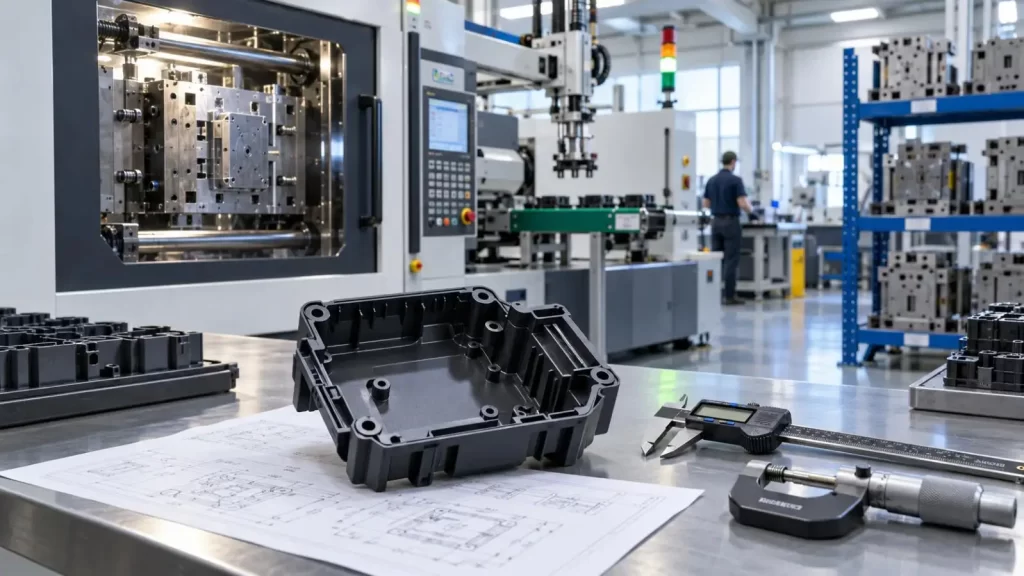
An Injection Molded Parts Manufacturer's dimensional report is useful only when the measurement method is reliable.
Agree on:
• Datums and Fixtures: Guide the measurement as free or constrained.
• Measurement Capability: Describe calibration, resolution, bias and Gauge R&R.
• Conditioning: Consider the time after molding. Describe the temperature of the mold and the atmospheric conditions of the molding.
• Traceability: Describe the production time, machine, resin lot, and cavity.
• Sampling: Describe the relevant production runs and the cavities prior to integrating the data.
By passing the first article inspection, it demonstrates that the sample fulfills the requirement. Capability assurance involves the submission of evidence related to the process to prove that the process is capable of fulfilling customer requirements.
Balance Precision With Manufacturing Cost
Yijiang's combined molding and CNC capabilities allow alternative manufacturing routes to be evaluated.
| Route | Main Benefit | Main Trade-Off |
| Revise geometry or tolerance allocation | Reduce sensitivity to variation | Requires functional revalidation |
| Improve tooling and molding conditions | Improve as-molded consistency | Additional engineering and tooling investment |
| Machine selected molded features | Control critical local interfaces | Recurring machining and fixturing costs |
Compare tooling amortization, cycle time, inspection, scrap, and assembly losses at the expected volume.
Prior to approving an Injection Molded Parts Manufacturer, obtain DFM feedback related to CTQs, first-article reports, cavitation-specific validation, and mutually agreed upon procedures for maintenance, process alterations, and nonconformances.
Discuss Your Precision Requirements With Yijiang
Share your drawings, resin specification, essential features of critical assemblies, and the anticipated quantities with Yijiang. Integrated production gives us the ability to address jigging tolerances, tooling selection, and a validation plan to support production of your project.
FAQs
Q1. What Services Does Yijiang Provide as an Injection Molded Parts Manufacturer?
Yijiang provides product design, mold development, injection molding, precision CNC machining, and integrated manufacturing support. Its services cover design review, tooling, molding trials, production, finishing, inspection, and delivery.
Q2. What Injection Molding Tolerances Can Yijiang Achieve?
Yijiang publishes injection molding tolerance capability of ±0.02 mm. Achievability depends on the specific dimension, resin, part geometry, mold design, and measurement conditions. Buyers should identify critical features on their drawings for project-specific evaluation.
Q3. What Injection Molding Equipment Does Yijiang Have?
Yijiang reports 30+ injection molding machines, with clamping forces ranging from 50 to 2500 tons, within a 10,000+ m² facility. Machine selection depends on projected area, shot volume, mold dimensions, and processing requirements.
Q4. Can Yijiang Manufacture Large Injection Molded Components?
Yes. Yijiang's website identifies large-component applications including 100-inch TV housings, automotive bumpers, and battery trays. Feasibility should be evaluated against part dimensions, material requirements, tooling size, and acceptable warpage.
Q5. Which Plastic Materials Does Yijiang List for Injection Molding?
Yijiang lists materials including ABS, PP, PC, PA6/66, PA12, POM, PMMA, PPS, TPE, TPU, and PC-ABS. Buyers should specify the required resin grade and performance criteria because shrinkage, stiffness, moisture absorption, and processing behavior vary by grade.
- PREV: Null
- NEXT: Null

Yijiang is a professional custom manufacturing partner specializing in large-scale injection molding and precision mold development. We support global clients in automotive,
in large-scale injection molding and precision mold development. We support global clients in automotive,


Get a quote from the China’s #1 CNC Machining Services.
Ready to get started? Connect with us today!
 Talk to Our Team