Custom Plastic Mold Development Trends in 2026: Smarter Tooling and Manufacturing

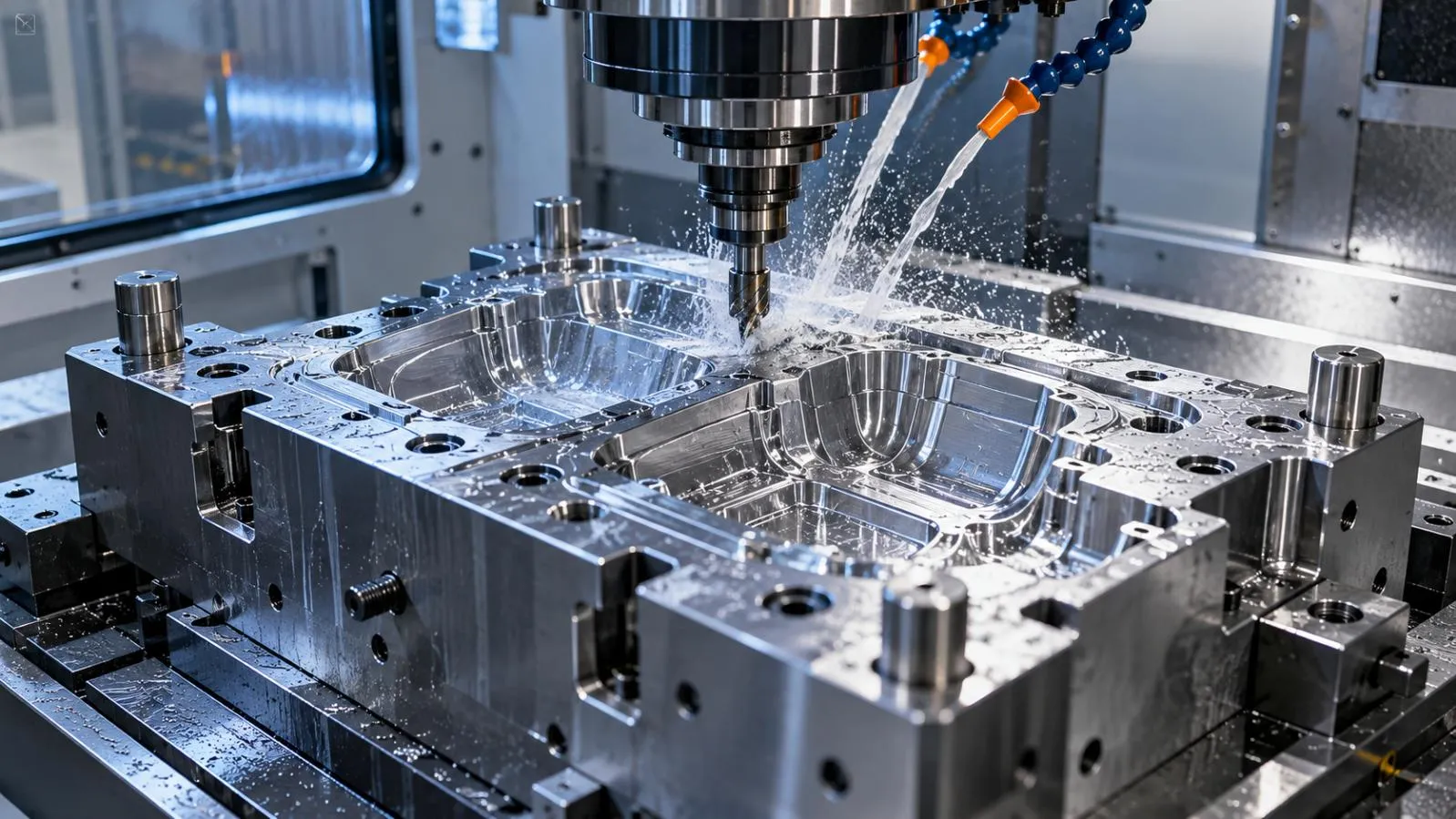
Table of Contents

- 1. Simulation-Driven Mold Design: Can Engineering Risks Be Resolved Before Machining?
- 2. Justification for Use of Conformal Cooling
- 3. Smart Mold Monitoring: Which Process Data Actually Help?
- 4. Material Selection: Why Do Sustainable Resins Change Tooling Requirements?
- 5. Tooling Architecture: Where Should Customers Allocate Their Budget?
- 6. Mold Acceptance: What Demonstrates Production Readiness?


Parts produced by the initial runs of the mold showed no defects. However, during prolonged production, warpage and sink marks were noted. An increase in packing pressure resolved the warpage; however, lateral flash was generated with this adjustment. It is possible the melt is shrinking to the mold in an undesired fashion. This may also be explained by a freeze-off at the gate, or lack of a uniform heat distribution in the cavity.
These types of problems complicate the Custom Plastic Mold Development process of 2026. Usually, in this instance, advanced, high-birth production equipment is purchased and utilized to resolve complications of this nature. Of late, it has been perceived that prior to tooling constrains, irregular process behaviors may be controlled through the integration of process and product coordination and life cycle controls. Additionally, other process risk mitigation strategies may need to be integrated as constraints are removed.
1. Simulation-Driven Mold Design: Can Engineering Risks Be Resolved Before Machining?
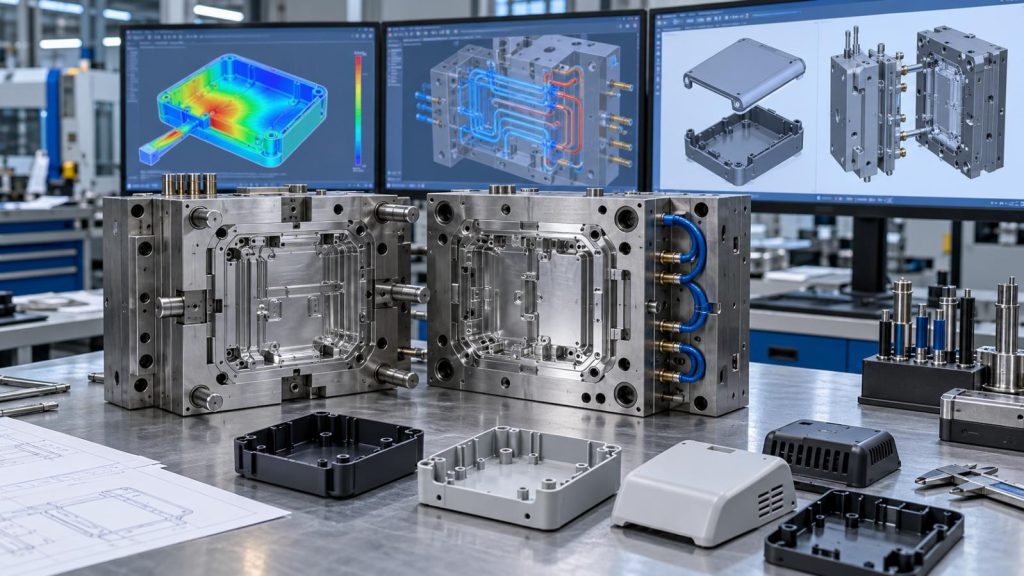
Moldflow simulation has become particularly valuable when conventional design rules produce conflicting recommendations.
Consider a glass-filled polyamide enclosure with deep ribs and multiple mounting bosses. A centrally located gate may reduce flow length and injection pressure, but it can also produce unfavorable fiber orientation around critical features.
Moving the gate changes the filling pattern, weld-line locations, packing-pressure distribution, and ultimately the direction of molded-part shrinkage.
What Simulation Needs to Establish
During Custom Plastic Mold Development, filling analysis alone is insufficient for parts with demanding dimensional requirements.
Engineers should consider:
• Filling and pressure loss: Consider potential air traps and hedging, determine if excessive mold pressures are approached or exceeded.
• Packing and gate freeze-off: Determine if the mold provides sufficient pressure to overcome gate freeze-off in thicker sections.
• Cooling and warpage: Consider effects of residual processing shrinkage, and fiber and resin orientation and assess potential thermal imbalances.
Accurate representation of the behavior of the resin is critical to the calculations. A generic PA6 model will not be adequate to represent all modified and glass-filled PA6 resins.
Even with accurate resin properties, warpage will be highly dependent on the assumptions made on fiber orientation, and the history and manner of processing.
Warpage can be verified through analysis of the filling and packing simulations and measurements. Adjustment of the assumptions made in the simulations should be made when measured results do not correlate to predicted results.
While AI design tools may assist in predicting design alternatives, physical correlations will be essential to predict warpage for a significant time in the future.
2. Justification for Use of Conformal Cooling
Economical and efficient use of mold space demands the use of straight drilled cooling channels. However, this can restrict the placement of cooling channels and lead to limitations when cooling deep and thick sections.
When a part has differences in thickness, areas of the part can retain residual stress and shrinkage. Longer cooling times can alleviate this issue, but will also affect cycle time for the entire mold.
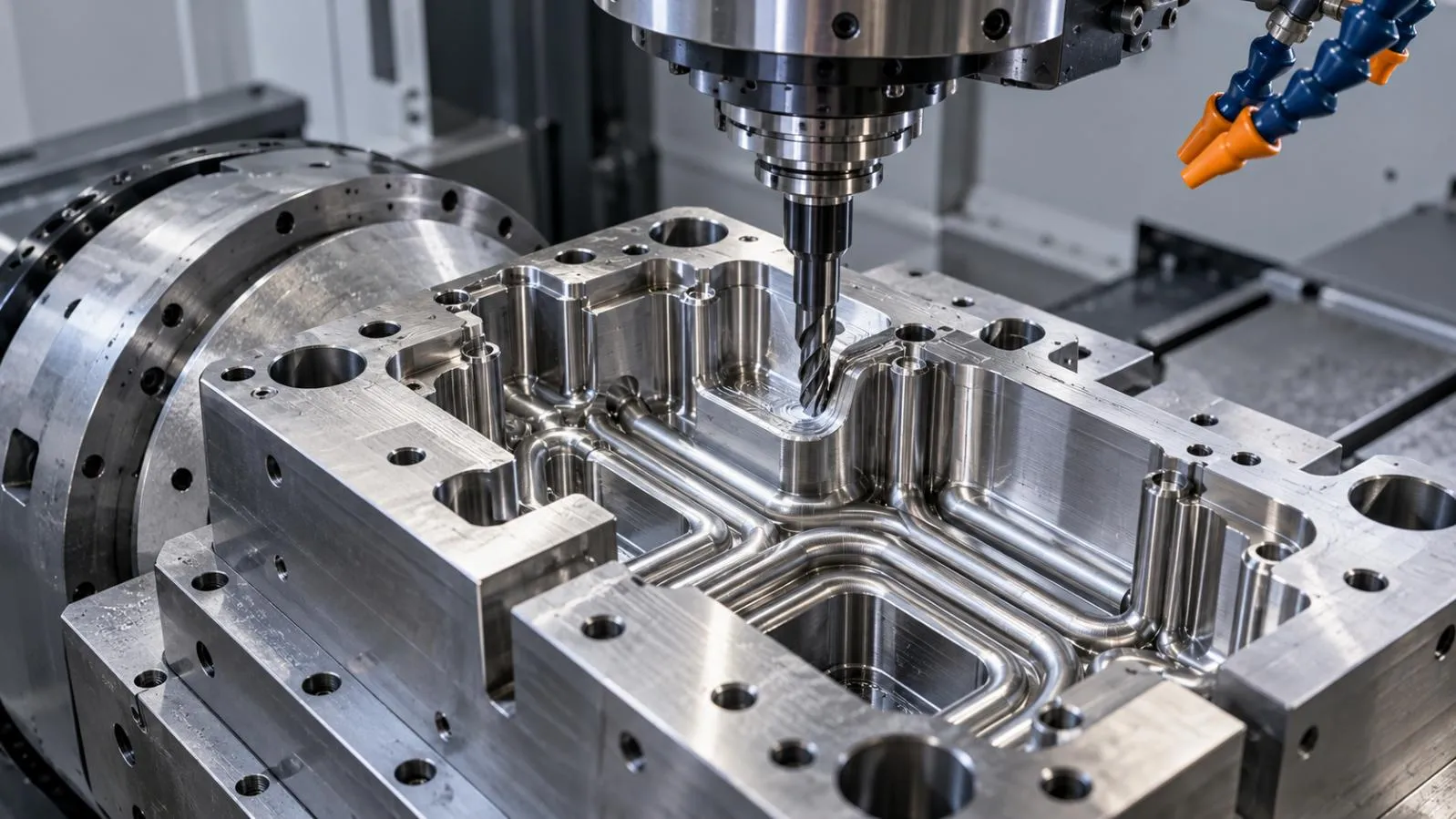
Metal additive manufacturing offers another approach: conformal cooling channels that follow selected cavity contours.
For complex mold inserts, this can reduce thermal nonuniformity without relying on excessive cooling of surrounding regions.
However, conformal cooling introduces its own engineering constraints.
Increased roughness in channels causes increased flow resistance, and complex structures can capture Metal Powder. Additionally, channels can become difficult to descale. If the steel between a channel and the cavity is too thin, that can cause structural and/or fatigue issues.
When reviewing Conformal Cooling, the following should be provided:
• A comparison of thermal analysis showing cooling times against a traditional cooling system.
• Analysis of cooling-water flow and pressure drop.
• Geometry of channels, wall thickness, and the material used in the channels.
• Provisions for cleaning, maintenance, and leak testing of the mold.
• A conventional mold with conformal cooling is often a better alternative to redesigning the entire cooling system.
The added cost of a mold should be justified by better profits from improved cycle times, or less rejection rates and waste.
3. Smart Mold Monitoring: Which Process Data Actually Help?
Injection pressure measured at the machine nozzle does not necessarily represent pressure inside the cavity.
Flow resistance changes as the melt advances through the runner, gate, and cavity. A process can therefore maintain consistent machine settings while experiencing different packing conditions near an end-of-fill feature.
Cavity-pressure sensors address this measurement gap.
Pressure traces show the behavior of filling, the transfer function of velocity to pressure, the behavior of packing and pressure decay. In combination with measurements of part weight and dimensions, the pressure trace data helps engineers decipher if the variance is due to raw material, process, or design of the mold.
Sensor location determines what can be observed. A transducer near the gate provides information about packing-pressure transmission but may not adequately characterize the last region to fill.
For critical applications, the sensor arrangement should be selected according to the suspected failure mechanism rather than installed solely to collect more data.
There are costs to consider: sensor pockets, wiring protection, calibration, controller integration, and replacement access.
Smart monitoring is therefore most useful when it supports a defined control or diagnostic objective. Without correlated inspection results and established action limits, additional data may provide little practical benefit.
4. Material Selection: Why Do Sustainable Resins Change Tooling Requirements?
Higher demand for post-consumer recycled (PCR) polymers and other modified engineering plastics creates another type of problem for tool engineers.
The use of recycled materials contributes to variations in melt viscosity, level of contamination, mechanical properties, and dimensional stability.
For semicrystalline polymers, variations in a given formulation or processing history can alter final cortical structure and dimensional stability.
Furthermore, with glass-filled polymers, the coarseness of the filler creates uneven cavity and gate/runner wear and anisotropic shrink stress.
Recycled polymers may be "as received" and quite limited in processing latitude.
They may require advanced qualification to ensure control of processing windows for melt flow, moisture content, shrinkage, and mechanical properties.
Once qualified, it is prudent to ensure the lots produced represent the polymer lots to be processed in production.
5. Tooling Architecture: Where Should Customers Allocate Their Budget?
The assessment of the total cost of ownership over the life cycle of the product is slowly replacing the need to assess only the cost to produce the product.
In some cases it may be justified to use more expensive tools in order to reduce the cost of owning the product over the life cycle of the product.
| Tooling Option | Where It Can Make Sense | Cost or Performance Limitation |
| Aluminum tooling | Prototypes and selected low-volume applications | Lower wear resistance and different thermal/mechanical behavior than tool steels |
| Hardened steel tooling | Long production runs and abrasive compounds | Higher initial machining cost and potentially longer lead time |
| Multi-cavity molds | Stable, high-volume production | Greater sensitivity to filling imbalance and cavity-to-cavity variation |
| Hot-runner systems | Applications where runner waste or cycle economics justify investment | Temperature-control complexity, leakage risks, and higher maintenance costs |
| Replaceable cavity inserts | Parts likely to require local revisions or wear-related replacement | Additional interfaces affecting alignment and heat transfer |
For multi-cavity tooling, evaluating gearality is not sufficient. Balance and consistency of runners and gates, along with even thermal and venting distribution, must be taken into consideration as well.
While greater cavity count increases potential part output, irregular filling and cooling results in greater scrap rate and decreases the number of acceptable parts.
Therefore, while evaluating tooling cost, procurement teams must consider the cost of part production, expected scrap rate, expected tooling maintenance, and anticipated tooling modifications.
6. Mold Acceptance: What Demonstrates Production Readiness?
A first article part produced by a mold meets the requirement of part production. It does not warrant a stable production process.
Prior to final acceptance, production of critical dimensions and/or cosmetic requirements must be stable over the processing window.
For high-risk features, the validation plan should include:
• Short-shot and packing studies where filling or pressure transmission is uncertain.
• Dimensional inspections at defined measurement and conditioning intervals.
• Cooling-circuit flow, leakage, and temperature checks.
• Repeated production trials using approved material and equipment.
• Measurement-system evaluation before relying on statistical capability results.
Where Cp, Cpk, or similar indicators are specified, the buyer and supplier must agree on sampling conditions, measurement methods, and acceptance criteria.
Resolving the requirements outlined below prior to production approval can help prevent the costs associated with tooling transfer, repair or modification.
Engineering Support from Yijiang Technology
Mold development at Yijiang Technology includes Design for Moldmaking (DFM) review, analysis using Moldflow, CNC and EDM machining, assemblies, trial moldings and post delivery maintenance.
For Custom Plastic Molding tools, our engineering team reviews various aspects of the Plastic Molding process like the selection of molding material and geometry of the part to be molded, the tooling structure and the production requirements. Please send us your drawings and highlight the critical parts in your specification to assist our engineering team in providing feasibility of the tooling and support services.
FAQs
Q1: What custom plastic mold development services does Yijiang Technology offer?
Yijiang Technology provides DFM analysis, mold design, Moldflow-based simulation, CNC and EDM machining, mold assembly, and trial molding.
Q2: How does Yijiang Technology evaluate mold manufacturability?
Yijiang reviews part geometry, wall thickness, draft angles, undercuts, gate placement, cooling requirements, and ejection risks before tooling.
Q3: Does Yijiang Technology use mold flow simulation?
Yes. Yijiang uses CAE-based mold flow analysis to assess filling behavior and identify potential molding defects before fabrication.
Q4: Can Yijiang Technology develop molds for both prototypes and mass production?
Yes. Yijiang offers rapid tooling for prototyping and low-volume production, alongside production tooling for larger manufacturing runs.
Q5: What tooling materials does Yijiang Technology use?
Yijiang selects tool steel, aluminum, and suitable alloys according to part complexity, production volume, and expected mold life.
- PREV: Null
- NEXT: Null

Yijiang is a professional custom manufacturing partner specializing in large-scale injection molding and precision mold development. We support global clients in automotive,
in large-scale injection molding and precision mold development. We support global clients in automotive,


Get a quote from the China’s #1 CNC Machining Services.
Ready to get started? Connect with us today!
 Talk to Our Team