DFM for Injection Molding: 10 Design Tips to Reduce Costs

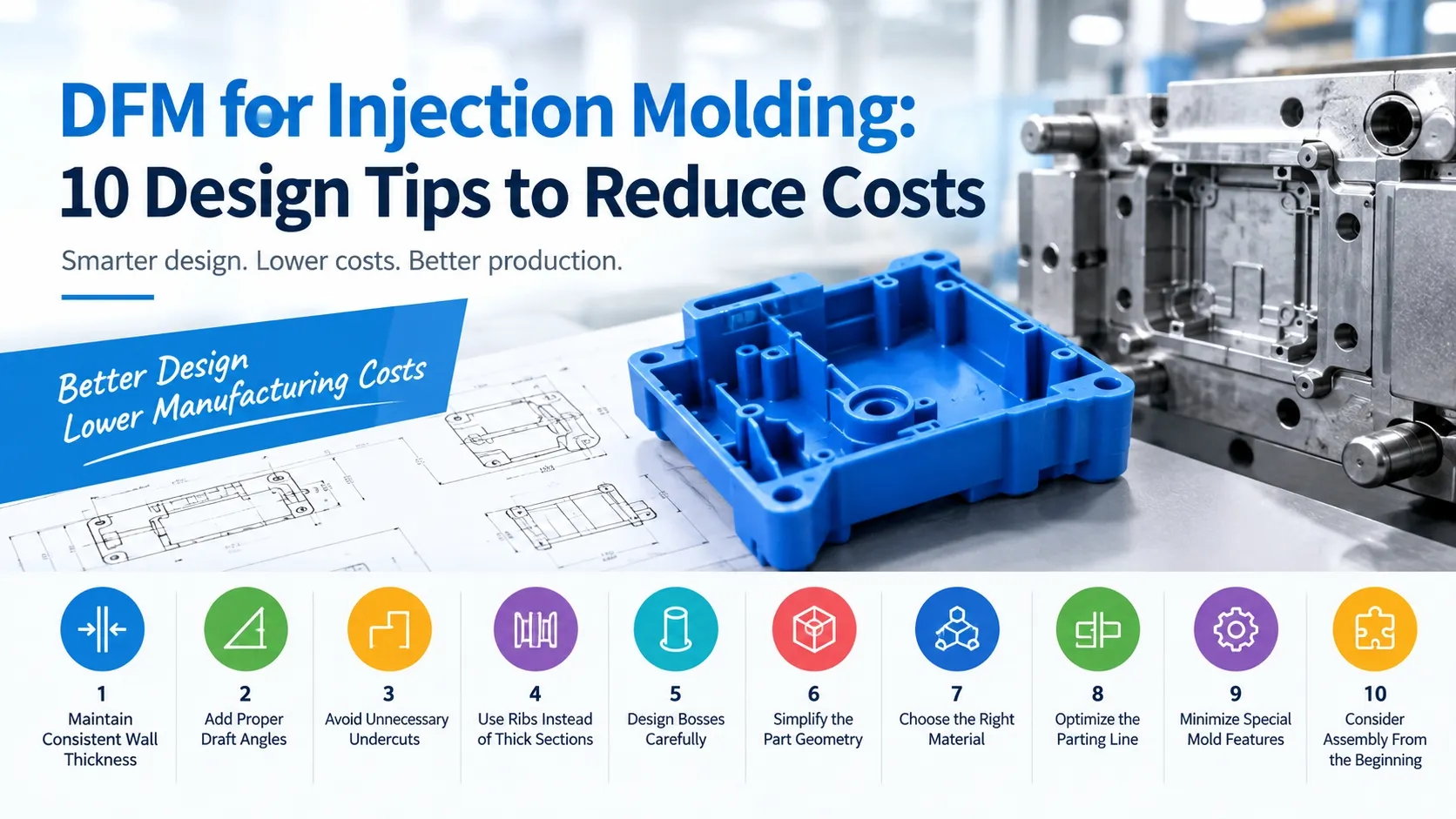
Table of Contents

- What Is DFM for Injection Molding?
- 1. Maintain Consistent Wall Thickness
- 2. Add Appropriate Draft Angles
- 3. Avoid Unnecessary Undercuts
- 4. Use Ribs Instead of Thick Sections
- 5. Design Bosses Carefully
- 6. Simplify the Part Geometry
- 7. Choose the Right Plastic Material
- 8. Optimize the Parting Line
- 9. Minimize Special Mold Features
- 10. Consider Manufacturing and Assembly From the Beginning
- Why DFM Should Happen Before Mold Manufacturing
- How DFM Reduces the Total Cost of Injection Molding
- Final Thoughts


Design for Manufacturing (DFM) is one of the most crucial processes in delivering a cost effective injection molded product. A well-designed plastic part will lead to decreased tooling cost, quick production, reduced defect, and enhanced manufacturing efficiency for the long run. A design that does not take injection molding into consideration, on the other hand, may become costlier due to having to change the mold, need extra machining, longer molding cycles, or need to make adjustments in the production process repeatedly.
If your company is creating custom plastic components, it is important to consider the principles of DFM at the beginning of the project to avoid a substantial increase in the overall cost of the project. It outlines 10 practical DFM tips for injection molding to help achieve lower manufacturing costs while retaining the quality and performance of the part.
What Is DFM for Injection Molding?
Design for Manufacturing (DFM): The process of designing a part in a way that allows it to be manufactured efficiently, reliably and economically.
DFM takes into account wall thickness, draft angles, ribs, bosses, undercuts, material selection, mold structure, parting lines, cooling and ejection for injection molding.
The purpose isn't just to make a part that can be molded. The objective is to develop a design that can be consistently, efficiently and at the lowest total cost, molded.
1. Maintain Consistent Wall Thickness
Relatively uniform wall thickness is among the most crucial injection molding DFM principles.
If there are big differences in the thickness of the walls, it can lead to uneven cooling and shrinkage. This can lead to warping, sink marks, internal stress and dimensional issues.
Design a part using ribs or other structural elements rather than using a very thick section for the desired strength with thicker and thinner walls.
For instance, a heavy solid wall might be replaced with a lighter wall with ribs. This decreases material usage, and may help to decrease cooling time.
Quality advantage: Less plastic material, faster moldings, and fewer quality issues can mean savings in both production and material expenses.
2. Add Appropriate Draft Angles
Draft angles are provided to make it easier to remove the molded part from the mold. If there is not enough draft, the part will adhere to the mould surface, which will lead to scratches, deformation or even be difficult to pull out.
This draft is dependent on the part geometry, mold depth, surface texture and material. Generally, smooth surfaces have less draft than textured surfaces.
Adding draft during the initial design stage is much more economical than redesigning the mold after manufacturing has started.
Cost benefit: Good draft eliminates ejection problems and reduces mould wear, changes, and production down time.
3. Avoid Unnecessary Undercuts
Undercuts are features that make it impossible to remove a part from a conventional two piece mold directly. They might need slides, collapsible cores, lifters or other special systems.
Underscores are sometimes required, sometimes they are not and if they are not, they can add too much complexity to the mold.
Review the design to determine if the undercut can be removed, moved or re-designed before finalizing the design. For instance, sometimes a functional item is modified to enable straight-pull molding.
Cost benefit: Easier molds usually involve fewer part numbers, fewer manufacturing processes, better maintenance and shorter manufacturing lead time.
4. Use Ribs Instead of Thick Sections
The ribs offer structural support without the bulk.
One of the typical errors is to thicken a plastic part to become stronger. Too much thickness, however, will result in creating sink marks and longer cooling times.
Efficient wall thickness may be achieved with strategically placed ribs.
Draft, rib thickness, height, and the possibility of sink marks on the opposite surface should also be taken into consideration when designing the ribs.
Cost benefit: Ribs can not only save materials but also enhance the structural performance and molding efficiency.
5. Design Bosses Carefully
Screws, pins, inserts, mounting points are often used with bosses. Unfortunately, an ill-designed boss may result in sink, voids or molding problems.
A solid thick boss may be avoided and a hollow boss with ribs used instead. Wall thickness and draft should be appropriate for the boss, as well.
Bosses attached to walls or ribs should be designed in a way that avoids abrupt changes in geometry, which can cause stress concentrations.
Cost benefit: Correct boss design can minimise defects, enhance assembly reliability and prevent waste of material.
6. Simplify the Part Geometry
High tooling costs occur with complex geometry.
Each extra feature may necessitate additional mold parts, CNC work, EDM operations, slides/inserts or special tooling. More maintenance may be necessary with a complex mold.
This does not imply that all items should be simple in terms of their geometry. Rather, consider if each feature offers any functional or aesthetic value.
Sometimes, the ability to combine several small features together into a simpler geometry can help decrease tooling complexity, while maintaining product functionality.
Cost benefit: A simplified geometry can lower the cost of mold manufacturing and shorten the tooling lead time.
7. Choose the Right Plastic Material
The choice of materials has an impact on more than just the performance of the product. It also affects molding temperature, shrink, cycle time, mold design, surface appearance and cost.
For instance, engineering plastics can offer high strength or temperature resistance, but be much more expensive than commodity materials.
When choosing a resin, take into account:
- Mechanical requirements
- Temperature resistance
- Chemical resistance
- Surface finish
- Shrinkage
- Processing temperature
- Availability
- Recycled or regrind content requirements
Do not automatically choose the most expensive material. Select a material that meets the actual application requirements.
Cost benefit: The right material can lower raw material costs and improve manufacturing efficiency without compromising product requirements.
8. Optimize the Parting Line
The parting line is where mold halves separate to release the molded component. Its location can influence tooling complexity, appearance, flash, ejection, and dimensional accuracy.
A poorly positioned parting line may require additional slides or create visible marks in important cosmetic areas.
During DFM analysis, consider whether the part can be molded with a simpler parting-line configuration.
For cosmetic products, the parting line should ideally be positioned in a less visible location. For functional components, dimensional and ejection requirements may be more important.
Cost benefit: A well-planned parting line can simplify tooling and reduce secondary finishing operations.
9. Minimize Special Mold Features
Mold inserts, slides, lifters, hot runners, unscrewing mechanisms, and other specialized components can provide valuable functionality, but they can also increase tooling costs.
Before adding a specialized mold mechanism, determine whether the same function can be achieved through a different part design.
For high-volume production, a more sophisticated mold may sometimes provide lower unit costs. For low-volume projects, however, expensive tooling features may not be economically justified.
This is why DFM should consider both tooling cost and expected production volume.
Cost benefit: Matching mold complexity to production requirements helps optimize total project cost rather than focusing only on the initial mold price.
10. Consider Manufacturing and Assembly From the Beginning
DFM should not stop at the molding process. Molded parts assembly, inspection, packing, shipping, etc. also should be taken into consideration by the designers.
Thus, fewer parts could make assembly easier, for instance. Standardization of fasteners, self locating features and snap-fit fasteners where applicable can help to decrease the amount of labor.
Accessibility for inspection and assembly equipment should also be adequate for the design.
In larger programs, any slight reduction in assembly time can translate to thousands or millions of dollars in savings.
Optimization across the molding and assembly can lead to cost benefit per finished product.
Why DFM Should Happen Before Mold Manufacturing
The earlier DFM problems are identified, the easier and less expensive they are to fix.
Changing a CAD model during the design stage is usually much cheaper than modifying a completed injection mold. Once tooling has been manufactured, changes may require welding, re-machining, new inserts, or even completely new mold components.
A professional DFM review can identify potential issues such as:
- Uneven wall thickness
- Insufficient draft
- Difficult undercuts
- Poor gate locations
- Potential weld lines
- Sink marks
- Warpage
- Ejection problems
- Mold cooling challenges
- Difficult parting-line locations
For this reason, DFM analysis should ideally be completed before final tooling approval.
How DFM Reduces the Total Cost of Injection Molding
Injection molding costs are influenced by many factors, including tooling, material, machine time, labor, secondary operations, scrap, and maintenance.
A DFM-focused design can address several of these costs simultaneously.
| DFM Factor | Potential Cost Impact |
|---|---|
| Uniform wall thickness | Reduces material and cycle time |
| Draft angles | Simplifies ejection |
| Fewer undercuts | Reduces mold complexity |
| Optimized ribs | Reduces material usage |
| Proper bosses | Reduces molding defects |
| Simple geometry | Lowers tooling costs |
| Suitable material | Controls material and processing costs |
| Optimized parting line | Simplifies mold construction |
| Fewer special mechanisms | Reduces tooling and maintenance |
| Assembly-friendly design | Reduces labor costs |
The biggest savings often come from avoiding problems before production begins.
Final Thoughts
DFM for injection molding isn't a matter of making the product design less complicated. It's the most efficient method of creating the necessary product.
Using consistent wall thickness, proper draft, minimizing unnecessary undercuts, using ribs properly, optimizing bosses and parting lines, selecting an appropriate material, and simplifying mold design helps minimize tooling costs, material usage, cycle times, and defect rates.
If a company is designing components for injection molding, it may be advantageous to have a seasoned injection molding manufacturer to offer feedback early in the design phase before tooling starts. The detailed DFM review process can transform a design that is difficult to manufacture into a more reliable and cost-effective production method.
Finally, the ideal injection molding design is delivered from the outset, taking into account the functional, aesthetic, manufacturing, quality and overall cost.
- PREV: Null
- NEXT: Null

Yijiang is a professional custom manufacturing partner specializing in large-scale injection molding and precision mold development. We support global clients in automotive,
in large-scale injection molding and precision mold development. We support global clients in automotive,


Get a quote from the China’s #1 CNC Machining Services.
Ready to get started? Connect with us today!
 Talk to Our Team